Best Visual Timers for Kids with ADHD: Features Parents Should Compare

The best visual timer for kids with ADHD is the Time Timer MOD or Yunbaoit 60-Minute Visual Timer. These devices combat time blindness by converting abstract minutes into a physical disappearing colored disk without stressful ticking noises. Pair silent operation with visual routine charts for seamless school and bedtime transitions.
Editorial Disclosure & Medical Scope: Sensory Kids Books shares neurodiversity-affirming, lived-experience insights and sensory-informed tools for parents, caregivers, and educators. This publication is for educational purposes only and does not constitute formal medical diagnosis, psychiatric evaluation, or clinical occupational therapy advice. Always consult a qualified pediatrician or licensed clinician for individual medical care. As an Amazon Associate, we earn from qualifying purchases through our independent affiliate links at zero extra cost to you.
⚡ Quick Takeaway & Summary for Parents:
Traditional digital and ticking clocks fail neurodivergent children because the ADHD brain experiences profound "time blindness"—an inability to internally feel or track temporal progression. An effective visual timer must feature (1) an intuitive disappearing colored disk or light progression, (2) truly silent quartz movement (zero auditory ticking anxiety), and (3) customizable transition alerts. For desktop study and homework, our top recommendation is the Time Timer MOD, while the Yunbaoit 60-Minute Timer offers the best value with silent flash alerts for classrooms.
Why Traditional Clocks Fail the ADHD Brain: The Science of Time Blindness
If you have ever asked your child to "put your shoes on, we are leaving in ten minutes," only to find them ten minutes later building an intricate Lego fortress without a single sock on their feet, you are not dealing with defiance or laziness. You are witnessing time blindness in real time.
Pioneering ADHD researcher Dr. Russell Barkley has repeatedly demonstrated that Attention Deficit Hyperactivity Disorder is fundamentally an executive function disorder of time and self-regulation. To the neurodivergent brain, time is experienced in only two primary dimensions: Now and Not Now. Standard analog wall clocks require complex mental spatial translation, and digital numbers (like "4:47 PM") are cold, abstract symbols that offer zero tactile sense of how much time is actually slipping away.
Visual timers solve this neurological mismatch by transforming abstract time into a physical, concrete quantity. By utilizing a high-contrast colored disk that physically shrinks clockwise as minutes tick down, a child can glance up from their homework desk and instantly see that only a small slice of red or teal remains. This externalizes executive function and dramatically reduces transition meltdowns.
5 Critical Features Parents Should Compare Before Buying
Not all visual timers are created equal. In fact, purchasing the wrong type can unintentionally amplify a child's anxiety. Here are the five non-negotiable features we evaluate:
- 1. Truly Silent Quartz Movement (Zero Ticking): Many mechanical kitchen timers emit a sharp, repetitive "tick-tick-tick" as they run. For children with sensory processing differences or auditory defensiveness, this sound acts as a sensory tormentor, preventing deep focus and causing hyper-fixation on the noise rather than the task.
- 2. Drop-Proof Silicone Casing: Children with ADHD and dyspraxia frequently knock desk items over. Timers with removable silicone bumpers or recessed plastic faces survive inevitable desk tumbles.
- 3. Volume Control & Silent Visual Alerts: A blaring buzzer that shocks a nervous system into fight-or-flight ruins the entire point of calm transitions. Look for models with adjustable volume levels, gentle chimes, or silent flashing LED lights for quiet classrooms.
- 4. Non-Anxious Color Palette: While bright red disks are standard, some kids interpret intense red as an urgent alarm. Calmer pastel tones (such as sky blue, sage, or soft coral) provide the same spatial boundary with less panic.
- 5. Battery vs. Spring-Wound Operation: Battery-powered quartz timers offer absolute silence and accurate countdowns. Spring-wound mechanical models eliminate battery replacements, but often feature slight background ticking.
The Top 4 Visual Timers for Kids with ADHD (Tested & Reviewed)
1. Time Timer MOD (60-Minute) — The Gold Standard Overall Pick
The Time Timer brand invented the disappearing colored disk concept, and the Time Timer MOD remains the undisputed gold standard for homework stations, OT clinics, and children's bedrooms. It features a compact desktop footprint, a removable protective silicone sleeve (available in calming charcoal, sky blue, or tie-dye), and a crystal-clear protective lens over the colored disk.
Sensory Advantage: The internal quartz movement is 100% silent—not even the faintest whisper of a ticking gear. The completion alert can be toggled to a gentle two-beep signal or muted completely for silent exam rooms.
Parent Drawback: Priced at the upper end of the timer category ($30–$35). Requires a single AA battery that must be secured behind a screw-locked panel.
👉 shopping_cartCheck Current Price & Colors for Time Timer MOD on Amazon (paid link)open_in_new
2. Yunbaoit 60-Minute Visual Countdown Timer — Best Value & Classroom Pick
If you need a reliable visual timer without the premium brand price tag, the Yunbaoit 60-Minute Timer offers remarkable functionality. It features a large, high-visibility 3-inch dial, a silent countdown mechanism, and dual volume controls (Low/Loud) plus a silent flashing red LED light mode.
Sensory Advantage: The silent LED flash mode is a lifesaver for kids who experience sensory overload from sudden auditory alarms. The child sees the gentle flashing light and knows their study interval has finished.
👉 shopping_cartCheck Current Price for Yunbaoit Visual Timer on Amazon (paid link)open_in_new
3. Secura Magnetic 60-Minute Visual Timer — Best for Kitchen & Refrigerator Routines
Morning departures and evening tooth-brushing routines often center around the kitchen and hallway. The Secura Magnetic Timer features two powerful rear magnets that securely adhere to refrigerators, magnetic whiteboards, and filing cabinets.
Sensory Advantage: Large bold numbers and high-contrast red disc that can be seen clearly across an entire open kitchen living room. Great for whole-family time management.
👉 shopping_cartCheck Current Price for Secura Magnetic Timer on Amazon (paid link)open_in_new
4. Learning Resources Time Tracker — Best for Stoplight & Gamified Transitions
For younger children (ages 3–7) or kids who feel heightened panic seeing a red disk shrink, the Learning Resources Time Tracker (Stoplight Timer) uses intuitive color transitions: Green ("Plenty of time left"), Yellow ("Wrapping up soon — 5 minutes left"), and Red ("Time is complete").
Sensory Advantage: Provides a non-punitive buffer stage. The yellow warning cue lets the child know that a transition is approaching without abruptly cutting off their dopamine-heavy task.
The Missing Half of the Equation: Why a Timer Alone Isn't Enough
A visual timer is an extraordinary sensory tool, but it only answers "How long?" It does not answer "What do I do next?" When the timer beeps or flashes, an ADHD brain that is unanchored to a visual schedule will immediately wander into distraction, dysregulation, or task paralysis.
To create calm, self-directed morning and bedtime routines, occupational therapists recommend pairing physical visual timers with Visual Schedule Strips. That is exactly why we created our companion printable toolkit:
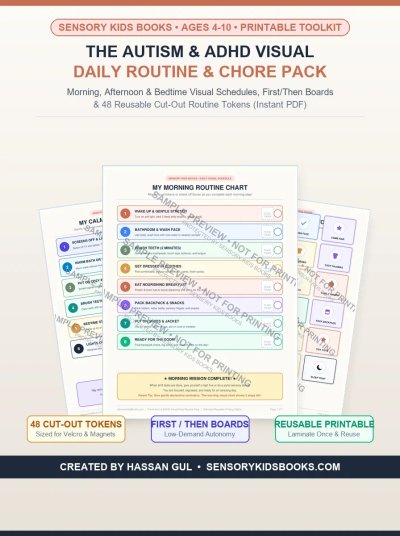
📋 Recommended Companion Printable: The Autism & ADHD Visual Daily Routine & Chore Chart Pack ($7.99)
Designed specifically for neurodivergent children ages 4–12, this instant downloadable kit features 72+ color-coded routine cards, morning & bedtime schedule boards, homework chunking strips, and visual "First-Then" reward cards. Print at home, laminate, and place directly next to your child's visual timer for an end-to-end calm executive function station.
👉 Get the Instant Printable Routine Pack ($7.99 Single Family / $14.99 Classroom License)
💡 Need a customized routine schedule right now? Try our Free Interactive Daily Routine Schedule Generator on our website to generate and print custom routine strips tailored to your family's day.
4 Ground Rules for Introducing a Visual Timer Without Triggering Anxiety
Many well-intentioned parents buy a timer, slap it on the table during homework, and declare, "You have 15 minutes to finish this math sheet or you lose iPad time!" When the child dissolves into tears or tears the worksheet, the parent assumes visual timers don't work.
To avoid turning a therapeutic tool into an instrument of punishment, follow these neurodiversity-affirming guidelines:
- Rule 1: Always Involve the Child in Setting the Dial — Autonomy is the antidote to demand avoidance. Instead of setting the timer yourself, ask: "Do you think cleaning up your markers will take 5 minutes or 8 minutes? Let's turn the red disk to 8 together." This creates personal ownership.
- Rule 2: Introduce the Timer with Preferred Activities First — Never debut a visual timer on a dreaded chore like math homework or tooth brushing. Practice with joyful activities: "We are going to play Magna-Tiles for 15 minutes! Watch the disk shrink." This builds positive neural associations.
- Rule 3: Use the "Body Break" Rule — Chunk tasks into manageable 15- to 20-minute blocks followed by a 5-minute sensory movement break (jumping on a trampoline, wall pushes, or drinking cold water through a straw). Pair this with your The ADHD & PDA Anti-Planner for optimal focus.
- Rule 4: Create a Sensory Calm Down Corner Nearby — If a transition triggers intense emotional overwhelm, pause the timer without shame and guide your child to your home calm down corner space until their nervous system regains safety.
Final Verdict: Which Visual Timer Should You Choose?
If your child needs a bulletproof, silent desktop timer with a protective silicone cover for elementary school and homework, invest in the Time Timer MOD. If you want a cost-effective alternative with silent LED flashing alerts for the classroom, choose the Yunbaoit 60-Minute Timer. For whole-family refrigerator routines, the Secura Magnetic Timer is unbeatable. Whichever you select, pair it with structured visual schedules to turn chaotic days into calm, predictable victories.
 Instant PDF
The Autism & ADHD Visual Daily Routine & Chore Chart Pack
Printable Morning, Afternoon & Bedtime Schedules, First/Then Boards & 48 Reusable Visual Routine Tokens (Instant PDF)
Quick Answers for Parents & Educators
Recommended Sensory Products
Carefully curated products for a sensory-friendly environment.
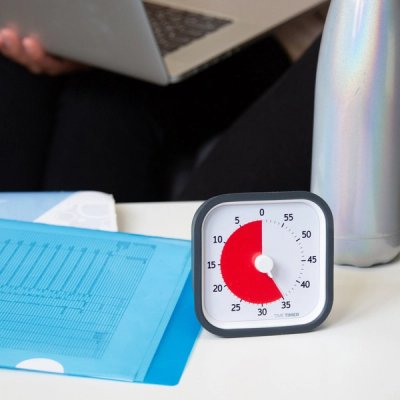
Time Timer MOD (60-Minute Silent Timer)
BEST OVERALL FOR ADHD
The gold standard visual countdown timer featuring a vanishing colored disk, protective silicone bumper case, and truly silent quartz movement to eliminate auditory ticking anxiety.
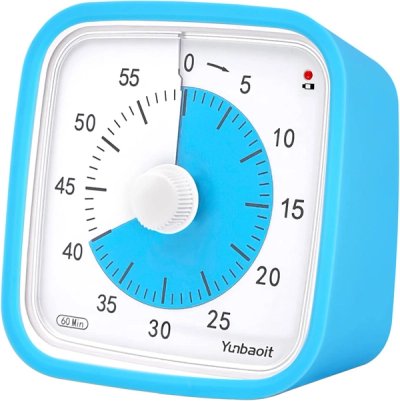
Yunbaoit 60-Minute Visual Countdown Timer
BEST FOR HOMEWORK DESKS
Vibrant modern design with high-contrast colored disk, dual volume controls, and a completely silent red LED flashing alert mode for quiet classrooms.
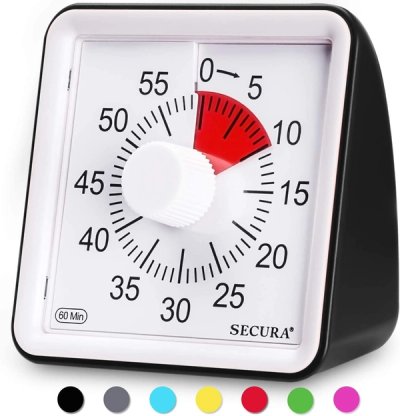
Secura Magnetic 60-Minute Visual Timer
BEST FOR REFRIGERATOR & KITCHEN
Equipped with dual heavy-duty rear magnets that attach firmly to refrigerators or classroom whiteboards. High-visibility red disk visible across an entire room.
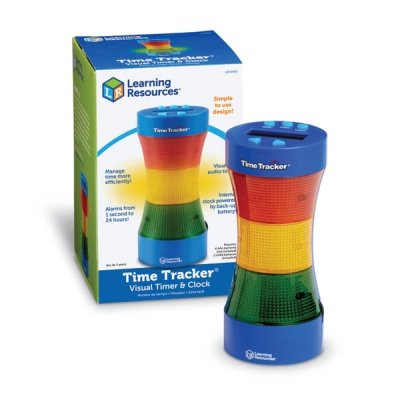
Learning Resources Time Tracker (Stoplight Timer)
BEST FOR GAMIFIED TRANSITIONS
Features 3-color light transitions (Green, Yellow, Red) and customized audio cues. Perfect for young children who get overwhelmed by a shrinking countdown disk.
📚 Evidence-Based Sources & Citations
Peer-reviewed literature, clinical frameworks, and foundational neurodiversity resources referenced in this guide.
- Occupational Therapy Practice Guidelines for Children and Youth with Challenges in Sensory Processing and Emotional Regulation — American Occupational Therapy Association (AOTA)(2021)View Sourceopen_in_new
- ADHD and the Nature of Self-Control: Executive Functioning and Time Blindness — Barkley, Russell A., Ph.D.(2015)View Sourceopen_in_new
- Scaffolding Executive Functions and Temporal Organization in School-Aged Children — CHADD (Children and Adults with Attention-Deficit/Hyperactivity Disorder)(2023)View Sourceopen_in_new
- Low-Demand Visual Accommodations and Predictive Scaffolding for Neurodivergent Learners — PDA Society UK(2022)View Sourceopen_in_new
Join the Conversation
Get our monthly guide on sensory-aware parenting and neuro-inclusive home design delivered straight to your sanctuary.
Respecting your inbox and your peace of mind.
Leave a Reply
Your email address will not be published. Required fields are marked *