Vagus Nerve Exercises for Kids: 7 Somatic Reset Tools to Calm Meltdowns & Sensory Overload
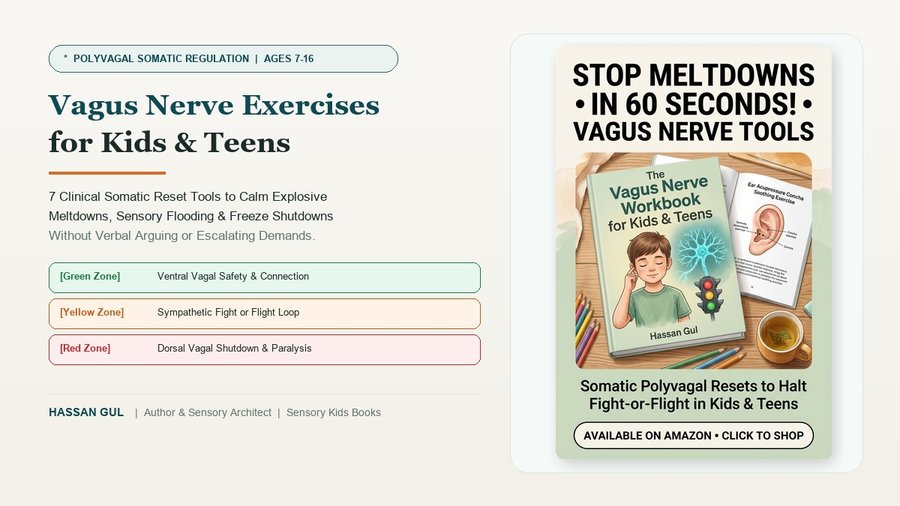
When your child is trapped in a screaming meltdown or frozen in shutdown, verbal logic fails. Discover 7 pediatric somatic vagus nerve exercises based on Polyvagal Theory to stimulate parasympathetic safety, restore vagal tone, and de-escalate sensory flooding in under 60 seconds.
Editorial Disclosure & Medical Scope: Sensory Kids Books shares neurodiversity-affirming, lived-experience insights and sensory-informed tools for parents, caregivers, and educators. This publication is for educational purposes only and does not constitute formal medical diagnosis, psychiatric evaluation, or clinical occupational therapy advice. Always consult a qualified pediatrician or licensed clinician for individual medical care. As an Amazon Associate, we earn from qualifying purchases through our independent affiliate links at zero extra cost to you.
Every parent of a neurodivergent child knows the exact look. The sudden glassy stare, the clenched jaw, the rapid shallow breathing, or the explosion of screaming over a sock seam that was "fine" five minutes ago. In that terrifying moment, every instinct you have as an adult tells you to talk. You try reasoning. You say, "It’s okay, take a deep breath, just calm down." And almost instantly, the explosion intensifies.
As a father who has walked through hundreds of sensory storms in our home and as an architect obsessed with physical systems, I learned this truth the hard way: you cannot talk a dysregulated nervous system out of a physical state of danger. When a child is in an amygdala hijack, their prefrontal cortex—the logical brain responsible for language, consequence, and reasoning—is completely offline. Blood has been redirected to the limbs, cortisol and adrenaline are flooding the bloodstream, and their autonomic nervous system is screaming that they are under physical attack.
The secret to calming a meltdown or thawing a frozen shutdown isn’t found in better arguments. It is found in Cranial Nerve X—the Vagus Nerve. By using targeted, pediatric somatic reset tools, parents can physically trigger the body’s innate parasympathetic "brake," signaling biological safety to the brainstem in under 60 seconds.
At a Glance: The 7 Pediatric Somatic Vagus Resets
Before we unpack the neuroscience of Polyvagal Theory, here is your quick-reference somatic emergency kit for meltdowns and sensory overload:
1. The Bumblebee Hum: Low-frequency laryngeal vibration that tones the vocal branch of the vagus nerve.
2. Auricular Concha Circles: Gentle circular acupressure on Arnold’s nerve branch in the inner ear hollow.
3. The Diver’s Cold Splash: Cold water or sensory gel on eyes to trigger the mammalian dive reflex and drop heart rate.
4. The Cross-Lateral Butterfly Hug: Bilateral rhythmic shoulder tapping to integrate brain hemispheres and down-regulate panic.
5. The Oculomotor Gaze Reset: Horizontal horizon eye holds that release suboccipital tension and induce a calming sigh.
6. Heavy Work Wall Pushes: Proprioceptive joint compression that burns off sympathetic adrenaline safely.
7. The Thick-Straw Smoothie Sip: High-resistance oral suction that stimulates the glossopharyngeal and vagal palate nerves.
What Is the Vagus Nerve? Polyvagal Theory in Plain English for Parents
The word "vagus" comes from the Latin word for "wanderer"—and that is exactly what it does. Starting at the base of the brainstem, this massive bundle of cranial nerve fibers wanders down through the neck, innervating the inner ear, throat, vocal cords, heart, lungs, and the entire gastrointestinal system. It acts as the bidirectional bidirectional superhighway of the Autonomic Nervous System (ANS).
Dr. Stephen Porges, the pioneering neuroscientist who developed Polyvagal Theory, demonstrated that our nervous system doesn’t just oscillate between "stressed" and "calm." Instead, human neuroception (our subconscious threat detection system) constantly sorts every environment into three distinct physiological states:
🟢 1. The Ventral Vagal State (The "Green Zone" — Social Safety): The myelinated front branch of the vagus nerve is engaged. Heart rate is steady, facial muscles are expressive, the inner ear tunes into the melodic cadence of human voices, and the child feels safe, curious, and connected.
🟡 2. The Sympathetic State (The "Yellow Zone" — Fight or Flight): When sensory overload, demand pressure, or perceived threat triggers the amygdala, the vagal brake releases. Heart rate surges, breathing becomes rapid and shallow, pupils dilate, and muscles coil for action. In children, this manifests as explosive screaming, physical aggression, throwing objects, or bolting.
🔴 3. The Dorsal Vagal State (The "Red Zone" — Freeze & Shutdown): When a situation feels inescapable or the sensory flood is catastrophic, the primitive unmyelinated back branch of the vagus nerve takes over. The nervous system slams on an emergency brake: heart rate plummets, limbs feel heavy like lead, speech becomes impossible (situational mutism), and the child appears completely limp, unresponsive, or frozen in task paralysis. This is not defiance; it is physiological collapse.
Why "Take a Deep Breath" Backfires During an Amygdala Hijack
Almost every well-meaning parent and educator tells a dysregulated child: "Just take three deep breaths." Yet nine times out of ten, the child gets angrier or starts hyperventilating. Why?
The secret lies in the biomechanics of the respiratory cycle. Inhalation naturally suppresses the vagus nerve and accelerates heart rate (a phenomenon known as Respiratory Sinus Arrhythmia). When an already panicked child tries to suck in huge gulps of air, they fill only their upper chest, signaling even more adrenaline to the brainstem.
The vagus nerve is activated only on the exhalation. To trigger parasympathetic deceleration, the out-breath must be twice as long as the in-breath, accompanied by vocal vibration or gentle resistance. That is why somatic exercises succeed where generic breathing drills fail.
The 7 Clinical Somatic Vagus Nerve Exercises for Kids
Here are 7 step-by-step somatic resets designed specifically for pediatric nervous systems, tested in occupational therapy settings and home calm-down corners:
1. The Bumblebee Hum (Bhramari Pranayama & Laryngeal Reset)
• The Science: The recurrent laryngeal nerve—a major branch of the vagus—wraps directly around the vocal cords and larynx. Low-frequency humming physically vibrates this nerve, prompting the release of nitric oxide in the nasal airways and signaling immediate bradycardia (heart rate slowing).
• How to Guide Your Child: Ask your child to place their gentle fingertips against the front of their neck. Have them take a gentle nose breath, close their lips, and make a deep, buzzing "hmmm" sound like a bumblebee flying home to its hive. Encourage them to see how long they can make the bee buzz (aiming for 6–8 seconds). The physical sensation of the throat rumbling beneath their fingers shifts focus from panicked thoughts to tactile vibration.
2. Auricular Concha Ear Circles (Arnold’s Nerve Branch Stimulation)
• The Science: The outer ear contains the only spot on the human body where the vagus nerve surfaces directly beneath the skin—specifically the auricular branch of the vagus nerve (Arnold’s nerve), which innervates the concha (the bowl-shaped hollow right above the ear canal).
• How to Guide Your Child: Have your child (or you, if they crave co-regulation touch) warm their thumbs, place the pads inside the bowl of each ear, and make tiny, slow, circular motions for 30 to 60 seconds. You can whisper: "We’re cleaning the calm-down bowl." Within 45 seconds, children often experience an involuntary deep breath or shoulder drop.
3. The Diver’s Mammalian Cold Splash (Trigeminal-Vagal Dive Reflex)
• The Science: When mammals submerge their faces in cold water, the brain activates the Mammalian Dive Reflex via the ophthalmic branches of the trigeminal nerve. The brainstem instantly assumes the body is underwater, reflexively slowing the pulse by 10% to 25% to conserve oxygen. It is nature’s fastest biological kill-switch for adrenaline.
• How to Guide Your Child: Keep a clean, damp hand towel in a plastic bag in the refrigerator or use a soft sensory cold pack. When a meltdown peaks, invite your child to lean forward and press the cool cloth over their closed eyes and upper cheekbones for 15 to 20 seconds. If they resist a cloth, washing hands with cold water or holding an ice cube in each palm delivers an immediate grounding temperature shift.
4. The Cross-Lateral Butterfly Hug (Bilateral Tactile Integration)
• The Science: Developed by trauma psychologists and widely used in pediatric somatic therapy, bilateral tapping rhythmically stimulates alternate hemispheres of the brain. This gentle tactile input activates mechanoreceptors that down-regulate the amygdala while fostering internal proprioceptive containment.
• How to Guide Your Child: Have your child cross their arms over their chest so their hands rest on opposite shoulders or upper arms, like butterfly wings. Instruct them to tap left, then right, then left, at a calm, metronome-like pace (about one tap per second). Model it silently beside them. After 15–20 taps, ask: "Are the butterfly wings starting to rest?"
5. The Oculomotor Gaze Reset (Stanley Rosenberg’s Horizon Shift)
• The Science: Pioneered by somatic bodyworker Stanley Rosenberg, this exercise targets the suboccipital muscles at the base of the skull where the vagus nerve exits the jugular foramen. Moving the eyeballs without turning the neck stimulates the oculocardiac reflex, activating the ventral vagal complex.
• How to Guide Your Child: Have your child interlock their fingers and cup them behind the back of their head. Keeping their head facing completely forward, ask them to move only their eyes all the way to the right, looking at the right corner of the room. Hold for 30 to 60 seconds without moving the head until an involuntary sigh, swallow, or yawn occurs. Then bring the eyes back to center and repeat looking far to the left.
6. Proprioceptive Heavy Work Wall Pushes (Burn Off Sympathetic Adrenaline)
• The Science: When the sympathetic system is flooded with adrenaline, the body has a biological imperative to move. Forcing a child to sit completely still during fight-or-flight can feel excruciating. Proprioceptive "heavy work" activates the Golgi tendon organs and muscle spindles, delivering dense organizing input that absorbs adrenaline without destructive hitting or kicking.
• How to Guide Your Child: Turn to a sturdy hallway wall. Have your child place their palms flat against the wall at shoulder height, step back onto their toes, and "push with all their might to make the room bigger." Count to 10 together, then release with a loud "whoosh" exhale. Repeat 3 times. For seated desk situations, a shopping_cartHarkla 5-lb weighted lap padopen_in_new placed across the thighs provides constant downward proprioceptive grounding.
7. The Thick-Straw Smoothie Sip (Palatal & Pharyngeal Suction)
• The Science: The glossopharyngeal nerve and vagus nerve share dense innervation across the soft palate, tongue base, and pharynx. Strong, rhythmic oral-motor suction requires coordinated breath control and stimulates the vagus nerve directly inside the mouth, while chewing and sucking release serotonin in the brainstem.
• How to Guide Your Child: Serve a thick, chilled fruit smoothie, Greek yogurt, or applesauce through a narrow reusable silicone straw or sports bottle. The physical muscular effort required to draw the thick liquid up the straw organizes breathing and forces a rhythmic pause in crying or hyperventilating. For kids who crave constant oral sensory input, provide a shopping_cartmedical-grade silicone sensory chew necklaceopen_in_new to relieve jaw clenching.
Pediatric OT Tools to Support Vagus Nerve Regulation
While somatic exercises require zero equipment, having tactile grounding and visual regulation tools ready in your home calm-down corner creates a dependable sanctuary for your child:
Compact 21x19 inch weighted pad featuring raised sensory minky dots. Delivers deep touch pressure to the large femoral nerves, anchoring restless legs during dinner, homework, and post-meltdown recovery.
shopping_cart👉 Check Current Price on Amazon (paid link)open_in_new
Mesmerizing descending colorful liquid droplets provide soothing visual tracking that naturally coordinates with oculomotor vagus nerve resetting, anchoring racing thoughts without demand.
shopping_cart👉 Check Current Price on Amazon (paid link)open_in_new
Durable, BPA-free sensory chewies that stimulate the vagus and trigeminal nerve branches innervating the masseter muscles and soft palate, preventing teeth grinding and clothes chewing.
shopping_cart👉 Check Current Price on Amazon (paid link)open_in_new
The 5 Involuntary Tells That the Vagus Nerve Has Engaged
How do you know if a somatic exercise is actually working, especially if your child is still too upset to speak? Watch their autonomic micro-behaviors. The autonomic nervous system leaves unmistakable physical clues when shifting from sympathetic arousal into ventral vagal safety:
1. The Spontaneous Deep Sigh: The brainstem triggers an involuntary double-volume breath followed by a long, audible release. This is the biological reset of respiratory sinus arrhythmia.
2. The Yawn: A yawn is not boredom; it is a rapid brain cooling mechanism that signals parasympathetic activation.
3. The Spontaneous Gulp or Swallow: During intense fight-or-flight, the salivary glands shut down (dry mouth). When the vagus nerve re-engages, salivation resumes and the child swallows involuntarily.
4. Shoulder Drop & Hand Unclenching: The trapezius and sternocleidomastoid muscles (innervated by Cranial Nerve XI, which works in tandem with the vagus) visibly relax, dropping shoulders 1–2 inches.
5. Abdominal Softening: The hard, defensive armor of the abdominal wall relaxes, allowing soft diaphragmatic breathing to return.
Vagus Nerve Exercise Comparison: Sensory Channel, Duration & Best Timing
Use this clinical summary table to match the right somatic exercise to your child’s specific meltdown phase and sensory profile:
• Bumblebee Hum: Auditory & Vocal Vibration | 30–60 seconds | Best for: Rumination, pre-meltdown whining, anxiety.
• Auricular Concha Massage: Tactile Acupressure | 45–60 seconds | Best for: Bedtime sensory overload, transition anxiety.
• Diver’s Cold Splash: Thermal & Trigeminal | 15–20 seconds | Best for: Peak explosive meltdowns, screaming, hyperventilation.
• Butterfly Hug: Bilateral Proprioceptive | 1–2 minutes | Best for: Post-meltdown shame, emotional crying, fear.
• Oculomotor Horizon Shift: Visual & Suboccipital | 60 seconds | Best for: Screen-time transitions, eye fatigue, sensory headaches.
• Heavy Work Wall Pushes: Proprioceptive Deep Pressure | 30–45 seconds | Best for: Physical aggression, urge to hit, kicking furniture.
• Thick-Straw Smoothie Sip: Oral-Motor Suction | 2–3 minutes | Best for: After-school restraint collapse, afternoon fatigue.
Looking for a Complete Illustrated Somatic Curriculum for Your Child?
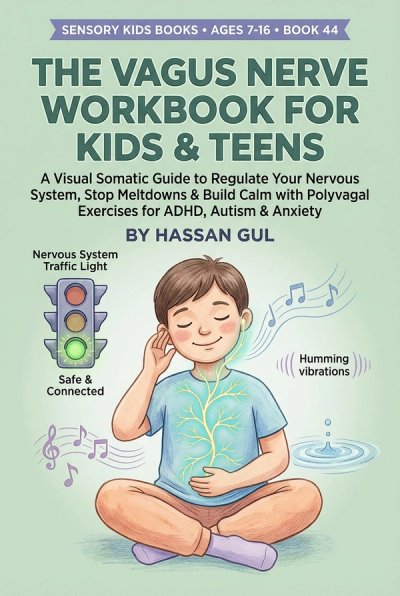
If you want 120 pages of hands-on somatic exercises, kid-friendly visual superpowers, and the official Polyvagal Traffic Light system, explore our complete workbook:
Written by Hassan Gul. Features 120 interactive illustrated pages including the Body’s Superhighway, Vagal Brakes, Throat Toning games, Thawing Freeze Protocols, and the Official Master Certificate of Regulation.
👉 View The Vagus Nerve Workbook in Our Official Bookshop ($8.99 Digital PDF / $14.99 Paperback)
Explore More Pediatric Nervous System & Regulation Guides
Deepen your family’s regulation toolkit with our companion clinical guides, printable templates, and interactive tools:
🧠 Autistic Shutdown vs Meltdown: Key Differences & Recovery Protocols
🛌 The 6 Best Weighted Blankets & Compression Vests for Autism & ADHD: An OT Guide
📋 The Free Sensory Diet Template: How to Build a Low-Demand Daily Schedule
🗣️ Free PDA Declarative Language Translator Tool (Instant Demand-Free Swaps)
The Ultimate Rule: You Cannot Regulate a Dysregulated Child with a Dysregulated Adult
Children do not possess mature self-regulation circuits. Their nervous systems borrow our autonomic regulation through co-regulation. If your shoulders are tense, your voice is sharp, and your heart is pounding, your child’s neuroceptive radar will detect your tension and stay locked in fight-or-flight.
Before you attempt any of these somatic resets with your child, do one yourself. Hum for 5 seconds. Drop your shoulders away from your ears. Take a slow physiological sigh. When you step into their storm as an anchor of biological calm, their vagus nerve will naturally find the path back to safety.
 Instant PDF
The Vagus Nerve Workbook for Kids & Teens
A Visual Somatic Guide to Regulate Your Nervous System, Stop Meltdowns & Build Calm with Polyvagal Exercises for ADHD, Autism & Anxiety
Quick Answers for Parents & Educators
Recommended Sensory Products
Carefully curated products for a sensory-friendly environment.
Harkla 5-lb Weighted Lap Pad for Kids (Dual-Texture Minky)
BEST SOMATIC GROUNDING TOOL FOR DESKS, CARS & MEALTIME
~$44–$49 | Compact 21x19 inch weighted pad delivering continuous deep touch pressure to the large femoral nerves. Sends immediate proprioceptive signals to the vagus nerve to calm motor restlessness.
Sensory Liquid Motion Bubbler Timer 3-Pack
BEST VISUAL OCULOMOTOR FOCUS & HORIZON SHIFT TOOL
~$15–$19 | Rhythmic descending gravity bubbles provide soothing visual tracking that naturally coordinates with oculomotor vagus nerve resetting, anchoring racing thoughts without demand.
Food-Grade Silicone Sensory Chew Necklace (Teardrop 4-Pack)
BEST ORAL-MOTOR VAGAL REGULATION & JAW DE-TENSIONING TOOL
~$12–$16 | Medical-grade silicone chewies that stimulate the vagus and trigeminal nerve branches innervating the jaw, masseter muscles, and soft palate during intense sensory flooding.
📚 Evidence-Based Sources & Citations
Peer-reviewed literature, clinical frameworks, and foundational neurodiversity resources referenced in this guide.
- The Polyvagal Theory: Neurophysiological Foundations of Emotions, Attachment, Communication, and Self-Regulation — Dr. Stephen W. Porges, W. W. Norton & Company(2021)View Sourceopen_in_new
- Vagal Nerve Regulation and Heart Rate Variability in Children with Autism Spectrum Disorder and ADHD — Frontiers in Human Neuroscience & Harvard Medical School(2022)View Sourceopen_in_new
- Somatic Experiencing and Autonomic Nervous System Modulation in Pediatric Sensory Processing — American Journal of Occupational Therapy (AJOT)(2023)View Sourceopen_in_new
- Accessing the Healing Power of the Vagus Nerve: Self-Help Exercises for Anxiety, Depression, Trauma, and Autism — Stanley Rosenberg, North Atlantic Books(2017)View Sourceopen_in_new
Join the Conversation
Get our monthly guide on sensory-aware parenting and neuro-inclusive home design delivered straight to your sanctuary.
Respecting your inbox and your peace of mind.
Leave a Reply
Your email address will not be published. Required fields are marked *