If you are raising a child with ADHD or Pathological Demand Avoidance (PDA), you have likely experienced the "Zero to 100" meltdown. It happens when you offer a seemingly harmless piece of constructive criticism—like asking them to fix a math problem or slightly adjusting how they load the dishwasher.
Instantly, the world ends. They might scream, "I'm so stupid!" or "You hate everything I do!" or completely shut down and retreat to their room.
As a parent, you are left standing there, completely bewildered, wondering why a simple request triggered an explosive emotional reaction. Traditional parenting books will tell you they are being defiant or dramatic. But if you dig deeper into the neurodivergent experience, you'll discover a phenomenon that explains everything: **Rejection Sensitive Dysphoria (RSD).**
Today, I want to talk about what RSD actually looks like in our home, why standard discipline will only make it worse, and how we finally learned to navigate these massive emotional waves without drowning.
What is Rejection Sensitive Dysphoria (RSD)?
Let's get the clinical facts out of the way first. **RSD is not a formal medical diagnosis** in the DSM-5. You cannot go to a doctor and get a specific billing code for it.
However, leading ADHD experts, such as Dr. William Dodson, estimate that a staggering **99% of adolescents and adults with ADHD experience some level of rejection sensitivity**. In fact, up to one-third of individuals with ADHD report that RSD is the most challenging, disruptive aspect of their condition—even more than focus or hyperactivity issues.
The word *dysphoria* comes from the Greek word meaning "unbearable." For a child with RSD, perceived criticism or failure isn't just a bummer; it feels like actual, physical pain. Their nervous system misinterprets a gentle correction as a massive, existential threat.
What RSD Actually Looks Like in a Child (My Experience)
- **The "Zero to 100" Meltdown:** It’s the instant rage when they misspell a word on their homework.
- **The Perfectionist:** They will refuse to try a new sport or video game because if they aren't instantly perfect at it, the shame of "failing" is too much for their brain to handle.
- **The People-Pleaser:** Some kids with RSD internalize the pain. They mask their feelings, become highly anxious, and bend over backward to please teachers and parents just to avoid the perceived threat of rejection.
- **School Avoidance:** They might beg to stay home from school, not because they are physically sick, but because the social dynamics of the playground are a minefield of potential rejection.
Why Typical Parenting Strategies Backfire with RSD
When I first encountered RSD meltdowns, I used the strategies I was taught growing up. I tried "Tough Love." I told my child, "You're overreacting, it's just a spelling test," or "Stop crying, nobody is mad at you."
These phrases are gaslighting to a neurodivergent nervous system.
When a child is experiencing an RSD episode, their amygdala (the brain's threat detector) has completely hijacked their prefrontal cortex (the logic center). Telling them to calm down is like telling someone drowning to just "swim better."
Punishing an RSD meltdown with a time-out or loss of privileges doesn't teach them resilience. It confirms their deepest fear: *I messed up, and now I am being rejected.*
5 At-Home Strategies to Support a Child with RSD
We cannot change how their brain is wired, but we can drastically alter their environment to make it feel safe. Here are the five low-demand, connection-first strategies we use at home.
1. Shift to Declarative Language
Instead of issuing direct demands (which trigger PDA and RSD), switch to declarative language.
- **Instead of:** "Fix this math problem, you did it wrong." (Triggers RSD)
- **Try:** "I notice this math problem looks a little tricky. I wonder if we should look at it together?" (Invites collaboration)
2. The "Praise to Correction" Ratio
Children with ADHD receive exponentially more negative feedback in a day than neurotypical children. You need to actively refill their emotional cup. Try to maintain a 5:1 ratio—five moments of genuine, specific praise for every one correction. "I love how focused you were while building that shopping_cartLEGO setopen_in_new," builds the armor they need to handle a correction later.
3. Creating a "Safe Harbor" Cool-Down Space
When the RSD rage hits, your child needs a place to land. We created a Safe Harbor in our home—a small corner with a bean bag chair, shopping_cartnoise-canceling headphonesopen_in_new, and dim lighting. When they run to this space, I do not follow them to lecture. I let their nervous system reset.
4. Building an "Emotion Vocabulary" Together
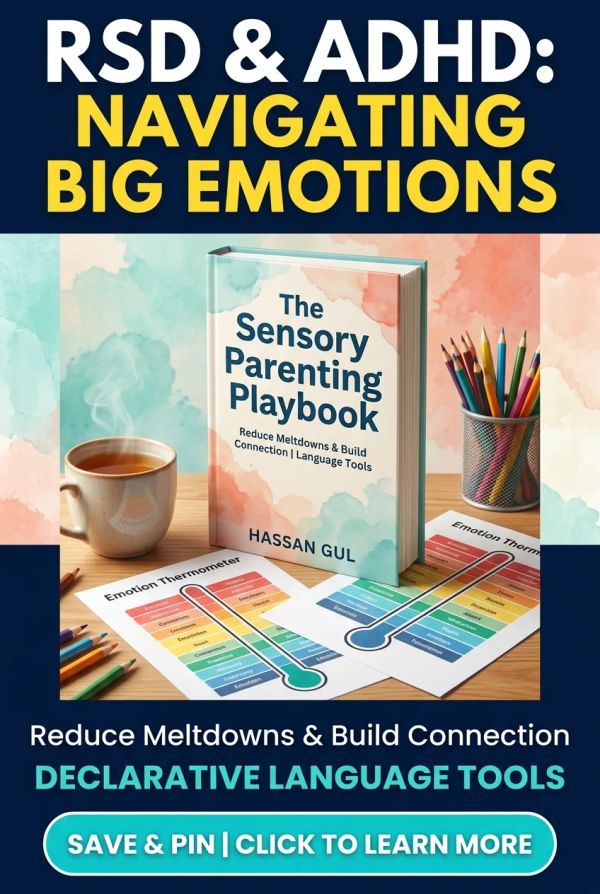
RSD feels confusing to the child experiencing it. We use an Emotion Thermometer to help give words to the feelings. Once they are calm (the Green Zone), we talk about what it feels like when their body hits the "Red Zone."
5. The Post-Meltdown Reconnect
This is crucial. After an RSD explosion, your child will likely feel intense shame. They *know* they overreacted, but they couldn't stop it. The most important thing you can do is repair the bond without shaming them. A simple, "That was a really big feeling. I love you, and we are okay," works miracles.
Free Printable Tools for Navigating RSD at Home
You don't have to navigate this blind. I have created a set of free digital tools specifically designed to help parents co-regulate with their RSD/ADHD children.
These printables include: The Emotion Thermometer (Visual Aid), "My Safe Space" Routine Cards, and a Declarative Language Cheat Sheet.
**👇 CLICK HERE TO DOWNLOAD THE SENSORY PLAYBOOK & PRINTABLES 👇**
Final Thoughts: You Are Not Failing as a Parent
If you are dealing with RSD daily, I know how isolating it feels. You might feel like you have to walk on eggshells in your own home just to keep the peace.
Please hear this: **You are not failing as a parent.** RSD is a neurological reality, not a behavioral flaw. By stepping away from traditional discipline and leaning into empathy and low-demand strategies, you are building a foundation of trust. Your child will learn that no matter how big their feelings get, your love is not contingent on their perfection.
Save for Later
📖 Related reading: If RSD is impacting your child's school experience, it's time to request a 504 Plan. Learn how here.
📖 Related reading: Does your child experience severe perfectionism and RSD when making mistakes? Read our guide on why Wipe-Clean Workbooks are a game-changer.