If you search the internet for autism tools, you’ll be bombarded with thousands of expensive, clinical-looking products that claim to be "essential." But if you’re raising a neurodivergent child, you already know the brutal truth: half of that stuff ends up untouched in the back of a closet.
I’m not an occupational therapist, and this isn't clinical advice. I am a parent who has spent years (and entirely too much money) trying to figure out what actually helps regulate an overloaded nervous system at home and in the classroom.
After years of trial and error navigating sensory processing challenges and emotional dysregulation, I’ve narrowed down the noise. Whether your child is a sensory seeker bouncing off the walls, or a sensory avoider who needs a quiet retreat, here is the ultimate list of **16 things autistic kids must have** to thrive both at home and at school.
The Must-Haves for Sensory Seekers (Home & Play)
If your child is constantly jumping, crashing, and spinning, their nervous system is craving proprioceptive and vestibular input. These are the heavy-work tools that save our living room furniture on a daily basis.
1. The Indoor Sensory Swing
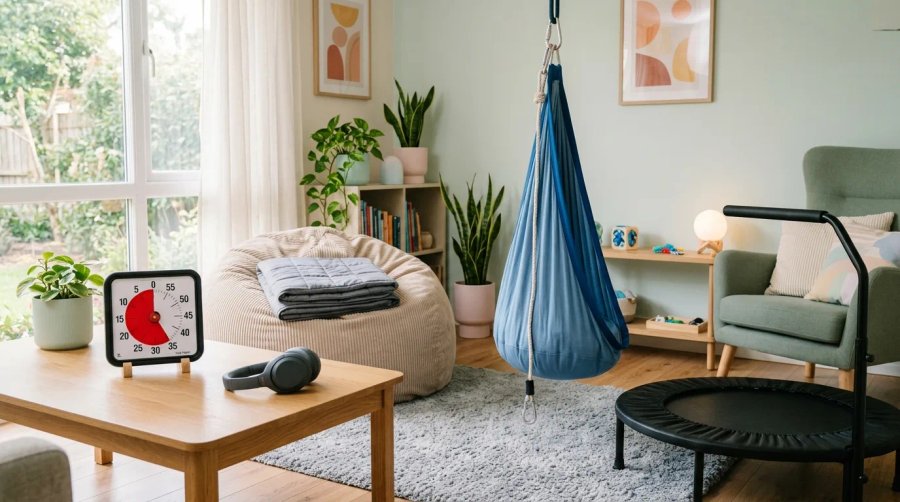
If I could only recommend one thing to parents of autistic children, it would be a shopping_cartsensory pod swingopen_in_new. The cocoon-like fabric provides deep pressure (proprioception) while the swinging motion provides vestibular input. It is the ultimate tool for rapid emotional regulation when a meltdown is brewing.
2. Sensory Body Socks
When my child is feeling completely scattered and dysregulated, the shopping_cartsensory body sockopen_in_newis a lifesaver. It’s essentially a giant, stretchy pillowcase they climb into. It pushes back against their movements, giving them full-body spatial awareness and a comforting, womb-like resistance.
3. Sensory Spinning Chair
Vestibular sensory seekers *crave* spinning. Instead of them spinning wildly and crashing into walls, a shopping_cartsensory spinning chairopen_in_newgives them a safe, focused way to get intense vestibular input. It helps drastically improve balance, core strength, and rapidly regulates their central nervous system.
4. Indoor Mini Trampolines
Stop yelling, "Stop jumping on the couch!" and just redirect them. A small shopping_cartindoor mini trampoline with a handleopen_in_newgives sensory seekers a safe, dedicated place to get that intense crashing input they desperately need, especially on rainy days when you can't get outside.
The Must-Haves for Sensory Avoiders (Managing Overload)
For children who get easily overwhelmed by loud noises, bright lights, or scratchy fabrics, the world can be an incredibly hostile place. These tools help them build a protective buffer.
5. Pediatric Noise-Canceling Earmuffs
A good pair of shopping_cartnoise-canceling earmuffsopen_in_newis non-negotiable. Whether it’s the vacuum cleaner, a loud grocery store, or a chaotic school cafeteria, these headphones allow them to participate in the world without their auditory system going into fight-or-flight mode.
6. Seamless Socks & Tagless Clothing
The wrong sock seam can ruin an entire morning. We completely eliminated clothing battles by switching to shopping_cartseamless socksopen_in_newand tearing the tags out of everything. It seems like a small detail, but when your tactile processing is hyper-sensitive, a rough seam feels like sandpaper.
7. A Cozy "Safe Harbor" Pop-Up Tent
Every autistic child needs a space that is completely theirs—a place to retreat when the world is too much. A simple shopping_cartindoor pop-up tentopen_in_newplaced in the corner of their bedroom or the living room acts as a low-stimulation sanctuary.
Must-Haves for School & Desk Work
School is the ultimate sensory gauntlet. The fluorescent lights, the sitting still, the unpredictable transitions—it’s exhausting. These tools help bridge the gap between home and the classroom.
8. Wobble Cushions (Active Seating)
For kids who simply cannot sit still in a hard plastic school chair, a shopping_cartwobble cushionopen_in_newis a game-changer. It allows them to subtly wiggle and engage their core, providing just enough sensory feedback to help them focus on the teacher instead of how uncomfortable their body feels.
9. Chewable Pencil Toppers
Does your child chew holes in their shirts or destroy their pencils? They are seeking oral motor input to self-soothe. Instead of correcting them, give them a safe alternative like shopping_cartchewable pencil toppersopen_in_new. They are discreet and perfect for classroom anxiety.
10. Silent Fidget Cubes
Spinners are great, but they are visually distracting to other students. A shopping_cartsilent fidget cubeopen_in_newcan be kept in a pocket or under a desk. The clicking, rolling, and rubbing motions help keep restless hands busy so the brain can focus on listening.
11. Magnetic Visual Schedule Boards
Transitions at school and home are notoriously difficult. A shopping_cartmagnetic visual scheduleopen_in_newallows the board to be the "bad guy." Instead of you issuing demands, the child can visually see what is coming next, which drastically reduces transition anxiety.
Must-Haves for Meltdown Management & Regulation
When the prefrontal cortex goes offline and a meltdown begins, you can't reason with them. You can only support their nervous system.
12. Weighted Lap Pads
A full weighted blanket is great for sleep, but a shopping_cartweighted lap padopen_in_newis portable. It provides Deep Pressure Therapy (DPT) which signals the brain to release serotonin and calm the nervous system. It's perfect for car rides or doing homework.
13. Wearable Chewelry
Similar to the pencil toppers, shopping_cartchewelry (chewable necklaces)open_in_newprovides a safe, wearable option for oral sensory seekers. Chewing provides heavy work to the jaw, which is one of the fastest ways to regulate a stressed nervous system.
14. Visual Countdown Timers
"We are leaving in five minutes" means absolutely nothing to a child with time blindness. A shopping_cart60-minute visual countdown timeropen_in_newturns abstract time into a concrete, disappearing red block. It is essential for managing screen time limits without the ensuing explosion.
15. Calming Liquid Bubble Timers
When a child is actively dysregulated, sometimes they just need something mesmerizing to stare at to help reboot their brain. A shopping_cartliquid motion bubbleropen_in_newis completely silent and visually soothing.
16. The Most Important Must-Have for Parents (Your Own Regulation)
This brings us to number 16. You cannot co-regulate a dysregulated child if your own nervous system is fried. Your child borrows your calm.
A Quick Tip for Parents:
If your child's vocal stimming or loud meltdowns trigger your own sensory overload, you have to protect your peace. Get yourself a pair of shopping_cartLoop Noise-Reducing Earplugsopen_in_new. They don't block out the sound entirely—you can still hear your kids perfectly—but they take the sharp, painful edge off the noise.
When you are calm, they feel it.
The Takeaway
You don't need to buy a warehouse full of therapy equipment to support your child. You just need to figure out if their nervous system needs more input (trampolines, chewelry, heavy work) or less input (earmuffs, tents, visual schedules) and build your toolkit from there.
Every child is different, but finding that one tool that finally helps them feel safe in their own body is worth its weight in gold.
Save for Later
📖 Related reading: Need to request these sensory tools for your child's classroom? Read our guide on getting a 504 Plan.
📖 Related reading: Looking for engaging sensory-friendly items? Discover the 10 Best Calming Activity Books for 5-Year-Olds.