Sponsored Content Placement
Book Recommendations
Autistic Shutdown vs. Meltdown: Understanding the Inward Collapse vs. Outward Explosion
self_improvementTake A Moment
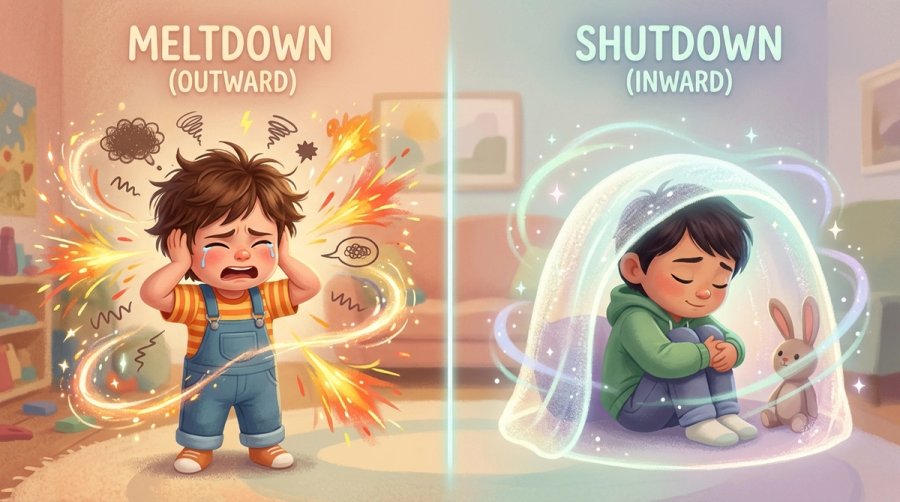
When an autistic nervous system exceeds its maximum capacity, it either detonates outward (a meltdown) or collapses inward (a shutdown). Discover the polyvagal biology of dorsal vagal freeze and how to provide emergency shutdown first aid.
Almost every book, seminar, and clinical article on autism focuses on the meltdown.
We all know what it looks like: the violent thrashing on the floor, the ear-piercing screaming, the kicked baseboards, the thrown toys. It demands immediate attention because it is loud, dangerous, and impossible to ignore.
But there is another, far more insidious side to neurological overwhelm. It is quiet. It looks like a child sitting motionless on their bed, staring blankly through the wall. It looks like a teenager who suddenly stops answering simple questions, dropping their head onto their arms at the kitchen table. When parents press them—"What’s wrong? Why are you ignoring me? Just answer yes or no!"—the child remains frozen.
To an untrained parent or educator, this behavior looks like defiant stonewalling, moody sulking, or giving the "silent treatment."
As both an autistic individual and a systems architect who analyzes physiological thresholds, I can tell you from the depths of my lived experience: that child is not ignoring you. Their nervous system has tripped the master breaker. You are witnessing an autistic shutdown.
To understand why one child screams while another becomes catatonic, we must turn to Dr. Stephen Porges’ Polyvagal Theory. When sensory input, emotional distress, or social demands surpass the brain's capacity to cope, the autonomic nervous system must protect the organism from lethal shock.
A meltdown is an outward explosion. The brain floods with adrenaline and noradrenaline. Heart rate skyrockets, pupils dilate, and motor energy is violently expelled through crying, running, flailing, or aggression. The organism is attempting to physically fight its way out of overwhelming danger. (For a deep dive on how to distinguish this from behavioral tantrums, see our guide on Autistic Meltdowns vs Tantrums.)
When fight or flight is impossible—or when sympathetic arousal fails to resolve the threat—the nervous system drops into the oldest evolutionary defense mechanism: the dorsal vagal freeze. Blood pressure and core temperature drop. Metabolic activity slows to a crawl. The brain actively cuts power to secondary systems—expressive language, fine motor control, and social engagement circuits—to preserve core vital organs. It is an involuntary systemic emergency shutdown.
I have been trapped inside shutdowns many times. It is terrifying from the inside. You are fully conscious. You can hear your parent or partner speaking to you. You desperately want to say, "I hear you, please give me five minutes," but the neural connection between your thoughts and your vocal cords is severed. Your tongue feels like a 50-pound cinder block.
Moving your hand feels like swimming through wet concrete. The sensory input from the outside world doesn’t stop—in fact, every sound and visual glare feels amplified, but your ability to respond has flatlined. When an adult gets angry and demands compliance during this state, it feels like someone beating on the door of a bunker while the air supply is running out.
Parents often ask me how to tell the difference between a shutdown and psychological trauma dissociation:
• Meltdown: High motor energy, loud verbalization, outward aggression, adrenaline discharge.
• Shutdown: Zero motor energy, involuntary mutism, slumped posture, metabolic conservation, physical lethargy.
• Dissociation: A psychological detachment from reality ("out-of-body" feeling, depersonalization, memory loss of the event), often triggered by chronic emotional trauma rather than acute sensory overload.
If your child enters an autistic shutdown, standard parenting instincts will make it worse. Here is the exact clinical and lived-experience protocol to follow:
Do not ask questions. Do not say, "What happened?" Even gentle questions require the auditory cortex to decode language, evaluate meaning, and formulate responses. To a dorsal vagal brain, every question feels like an intolerable demand. Speak only a single grounding sentence: "You are safe. There are zero expectations. I am here."
A shutdown brain is desperate for zero-input environments. Remove harsh overhead lighting, close the curtains, and eliminate background noise.
Proprioceptive input (deep pressure) stimulates parasympathetic tone without requiring verbal interaction. Place a weighted lap pad or weighted blanket across their shoulders or legs.
Never force spoken words. If you must know if they need water, bathroom, or rest, offer visual communication cards or non-verbal pointing tools.
Rebooting from a shutdown is not like flipping a light switch. It is like rebooting a slow operating system after a hard crash. When the child begins to move again, their speech may be slow, hesitant, or monotone. They may experience temporary motor clumsiness and extreme fatigue.
Do not immediately plunge them back into chores, homework, or social demands. Their energetic battery has been drained to zero. (Learn more about spoon depletion in our companion article on Spoon Theory for Neurodivergent Kids.)
To build a home environment that stops meltdowns and shutdowns before they start, explore The ADHD & PDA Anti-Planner, and check out the Emotion Monsters Series to give your child the visual safety tools they need to communicate before the fuse blows.
 Instant PDF
A Declarative Language & Co-Regulation Guide to Reduce Meltdowns, Build Autonomy, and Navigate Daily Routines with Pathological Demand Avoidance
Carefully curated products for a sensory-friendly environment.

BEST FOR FOCUS
Providing 5lbs of gentle pressure to help children stay grounded during long reading sessions.

SENSORY FRIENDLY
Flicker-free technology with adjustable color temperatures to prevent eye strain.
Get our monthly guide on sensory-aware parenting and neuro-inclusive home design delivered straight to your sanctuary.
Respecting your inbox and your peace of mind.
No comments yet. Be the first to share your thoughts!
Your email address will not be published. Required fields are marked *