Every August and September, millions of well-meaning parents buy their teenagers a brand-new, $35 leather-bound planner with high hopes. By the second week of October, that planner has joined what every neurodivergent adult knows intimately: the Planner Graveyard.
It sits on their bedroom desk, untouched and abandoned. And every time your teen glances at it, it delivers a silent dose of shame: 'You failed again. You can't even keep track of your homework.'
Here is what most parents and school guidance counselors don't realize: Traditional planners do not teach executive functioning skills. They require executive functioning skills to use in the first place.
As an adult with ADHD and a software systems architect, I spent over a decade analyzing why traditional productivity systems collapse the moment they encounter an interest-based nervous system. In this comprehensive buying guide, we break down the neuroscience of ADHD task paralysis and highlight the 3 best sensory-friendly, low-demand planners engineered specifically for how ADHD teen brains actually work.
The 3 Neurological Reasons Traditional Planners Fail ADHD Teens
Before you purchase another academic calendar, it is vital to understand the cognitive friction your teenager experiences every single day.
1. Severe Time Blindness (The Absence of 'Future' Perception)
Neurotypical brains have a visceral, internal clock that senses the passage of hours, days, and weeks. For an ADHD teen, time exists in only two distinct zones: 'NOW' and 'NOT NOW.'
When a teacher assigns a history term paper due in three weeks, that project lives in 'NOT NOW.' Because it produces zero immediate dopamine or panic, the prefrontal cortex cannot prioritize it. Traditional planners demand that teens map out long-range milestones across blank monthly grids. To an ADHD brain, looking at an empty 30-day grid is like staring into an abyss—it induces immediate cognitive shutdown.
2. Working Memory Bottlenecks ('Out of Sight, Out of Mind')
Working memory is the mental sticky note of the brain. While a neurotypical student can hold 5 to 7 pieces of information in their mental scratchpad, an ADHD student often maxes out at 2. If a planner requires opening a closed cover, flipping to a bookmark, checking a weekly tab, and cross-referencing a class syllabus, that cognitive friction is insurmountable. If the plan is not visually present on the desk, it ceases to exist.
3. The Dopamine Deficit & The 'Wall of Awful'
ADHD is fundamentally a regulation disorder of dopamine and norepinephrine. The brain is starved for stimulation. A list of dry, boring chores ('Study 30 minutes for chemistry') triggers an involuntary physiological resistance known as the 'Wall of Awful.' Without dopamine rewards baked into the system, the body physically resists initiating the task.
The 3 Best Sensory-Friendly Planners for ADHD Teens
To overcome these neurological hurdles, an ADHD planner must be visual, low-demand, gamified, and forgiving. If a teen misses three days or two weeks, they should not have to face a glaring wall of blank dates. Here are our top three recommended systems:
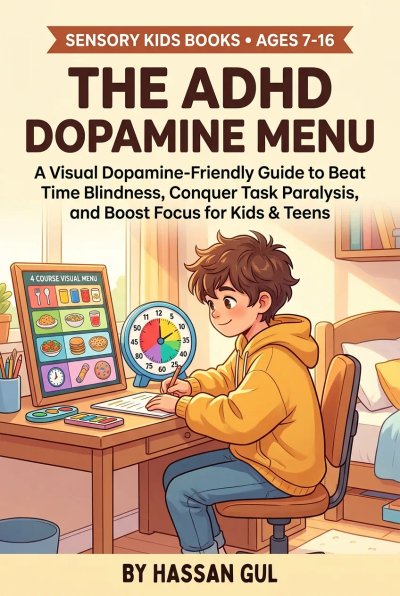
1. The ADHD Dopamine Menu & Executive Function Toolkit
Best for: Conquering task paralysis, time blindness, and dopamine depletion (Ages 10–18).
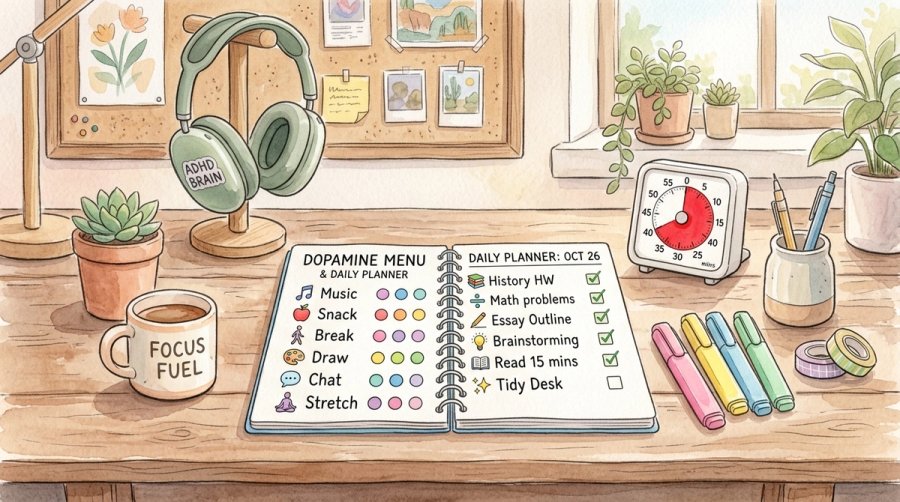
Instead of treating life like an endless military to-do list, this system reframes daily tasks using the restaurant 'Dopamine Menu' concept popularized by neurodiversity advocates. It splits activities into appetizers, entrees, side dishes, and desserts:
- 🥗 Appetizers (Quick Dopamine Sparks): 5-minute low-friction resets to get moving: listening to 1 favorite upbeat song, doing 10 jumping jacks, rolling on a yoga ball.
- 🍲 Entrees (Core Deep Focus Work): Breaking high-friction tasks into micro-steps (writing 3 bullet points of an essay outline instead of 'Write Essay').
- 🍟 Sides (Body Doubling & Background Input): Adding sensory stimulation to make boring work tolerable: brown noise playlists, walking treadmill pads, chewing sensory gum.
- 🍨 Desserts (High Dopamine Rewards): Guilt-free gaming or video time earned after finishing an entree.
The toolkit also includes a visual time tracker and printable daily checklist sheets with zero dates—allowing teens to start, pause, and resume without guilt.
👉 Explore The ADHD Dopamine Menu & Executive Function Toolkit Here
2. 52 Modern Manners for Teens & Young Adults (Guided Edition)
Best for: Social confidence, digital etiquette, and unwritten life skills (Ages 13–19).
Many ADHD teens struggle not just with homework, but with the hidden social demands of high school: texting etiquette, ordering food at restaurants, asking teachers for extra time on tests, and handling rejection sensitivity dysphoria (RSD).
Traditional planners ignore social executive function completely. This 52-week guided workbook provides one bite-sized, real-world mission per week. Each page takes less than 5 minutes to read and includes practical scripts, checkbox challenges, and self-reflection prompts. It eliminates overwhelm while teaching teens how to navigate the modern world with self-respect.
👉 Explore 52 Modern Manners for Teens (Guided Edition)
3. The ADHD & PDA Anti-Planner
Best for: Teens who experience intense Pathological Demand Avoidance and school burnout.
For teens with both ADHD and Autism (AuDHD) or a Pathological Demand Avoidance (PDA) profile, standard planner prompts feel like aggressive demands from an authority figure. The nervous system instantly rebels with panic or shutdown.
The Anti-Planner turns organization upside down. It is completely undated and gamified. It features 'Choose Your Own Adventure' decision trees, reverse to-do lists ('Things I Did Today' instead of things to do), and visual energy meters. It is designed to be written in with colored pens, scribbled on, or skipped entirely without penalty.
👉 Explore The ADHD & PDA Anti-Planner Here
4 Essential Physical Tools to Pair with an ADHD Planner
A planner alone cannot fix an unsupportive sensory environment. To help your teen build sustainable planning habits, pair their workbook with these four sensory-friendly workspace essentials:
1. Time Timer 60-Minute Visual Countdown Clock
Digital smartphone timers are a trap—picking up a phone to check the timer inevitably leads to 45 minutes lost on TikTok or Instagram. The Time Timer is a mechanical desk clock with an eroding red disc. As time passes, the red disc physically shrinks, giving the teen an instant, non-distracting visual representation of 'time left.'
shopping_cartCheck Price on Amazon: Time Timer 60-Minute Visual Clockopen_in_new
2. Rocketbook Erasable Reusable Notebook
Many ADHD teens have perfectionism paralysis—they hate making a mistake on paper, which prevents them from writing down their assignments. Rocketbook pages can be written on with FriXion pens and wiped clean with water. It allows infinite resets with zero paper waste.
shopping_cartCheck Price on Amazon: Rocketbook Core Reusable Smart Notebookopen_in_new
3. Zebra Mildliner Dual-Tip Pastel Highlighters
Fluorescent yellow highlighters create high visual glare that tires sensory-sensitive eyes. Pastel mildliners provide soft, pleasant color coding (e.g. green for homework done, purple for breaks) that makes visual organization soothing rather than overwhelming.
shopping_cartCheck Price on Amazon: Zebra Mildliner Pastel Highlighters (15 Pack)open_in_new
4. Magnetic Fidget Decompression Pen
Fidgeting is not a distraction for ADHD teens—it is a physiological necessity to maintain executive alertness. A magnetic pen allows subtle, quiet sensory manipulation during study sessions without disrupting focus.
shopping_cartCheck Price on Amazon: Magnetic Fidget Desk Penopen_in_new
How Parents Can Support Planning Without Nagging
If you find yourself constantly saying 'Did you write that down?' or 'Check your planner!', you are taking on the executive burden yourself. Here is how to transition into a supportive co-regulator:
- ⏰ The 5-Minute Sunday Brain Dump: Sit together on Sunday afternoon with snacks and a favorite drink. Spend exactly 5 minutes writing down all known assignments and appointments on sticky notes. Do not force them into an order yet.
- 🧱 Use 'Body Doubling': Sit at the same table working quietly on your laptop while your teen reviews their planner. The passive presence of another focused human dramatically lowers the activation energy required to start.
- 🗣️ Shift to Declarative Observations: Instead of 'Go check your planner right now!', say: 'I notice you have an English exam this Thursday. Let me know if you want help picking an entree from your dopamine menu.'