Gestalt Language Processing in Autism: Why Your Child Speaks in "Scripts"
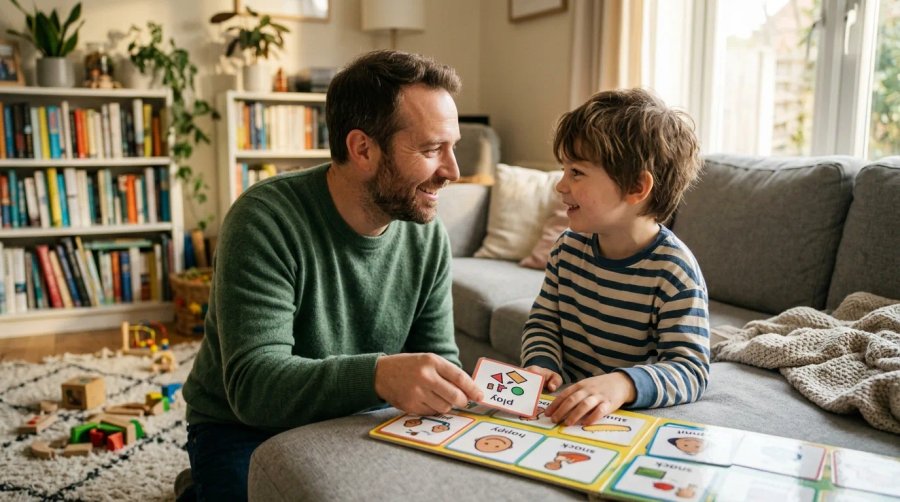
Gestalt Language Processing (GLP) is a natural style of language acquisition where children learn speech in whole phrases ('gestalts' or scripts) before breaking them down into individual words.
Editorial Disclosure & Medical Scope: Sensory Kids Books shares neurodiversity-affirming, lived-experience insights and sensory-informed tools for parents, caregivers, and educators. This publication is for educational purposes only and does not constitute formal medical diagnosis, psychiatric evaluation, or clinical occupational therapy advice. Always consult a qualified pediatrician or licensed clinician for individual medical care. As an Amazon Associate, we earn from qualifying purchases through our independent affiliate links at zero extra cost to you.
"To infinity and beyond!"
When your four-year-old says this, you might smile at the *Toy Story* reference. But what if they say "To infinity and beyond" every time they want to go outside? What if they say "I'll be back" when they are hungry, or sing the *Daniel Tiger* theme song when they are overwhelmed?
If your child communicates heavily through scripts, movie quotes, or delayed echolalia, you might have been told by well-meaning professionals that their speech is "non-functional" or "meaningless repetition."
As a technical architect and a neurodivergent advocate, let me assure you of one critical truth: It is not meaningless.Your child is communicating profoundly. They are simply learning language through a completely different operating system known as Gestalt Language Processing (GLP).
In this comprehensive guide, we are going to bypass the dense clinical jargon used by speech-language pathologists. Instead, we are going to look at GLP through a neuro-affirming, parent-first lens. By the end of this article, you will understand exactly how your child’s brain is acquiring language, the 6 stages of this process, and exactly how you can support them at home.
What is Gestalt Language Processing (GLP)?
To understand Gestalt Language Processing, we first have to understand how we were *taught* that children learn language.
The Analytic Processor (Word-by-Word)
Most neurotypical children are Analytic Language Processors. They learn language from the bottom up. They start with single units (words), then combine them into two-word phrases, and eventually build original sentences.
- *Stage 1:* "Milk."
- *Stage 2:* "Want milk."
- *Stage 3:* "I want more milk, please."
They are building with individual Lego bricks.
The Gestalt Processor (Chunk-by-Chunk)
Many autistic children (and some neurotypical children) are Gestalt Language Processors. They learn language from the top down. "Gestalt" means *whole*. These children do not hear individual words; they hear entire "chunks" of language, complete with the specific intonation, emotion, and melody of the speaker.
- *Stage 1:* "Do you want some milk?" (Said exactly the way you said it to them).
- *Stage 2:* "Do you want some + juice?"
- *Stage 3:* "I want juice."
Instead of starting with single Lego bricks, the Gestalt processor starts with a pre-built Lego castle. Their language journey involves slowly breaking that castle down into individual bricks so they can eventually build their own sentences.
The Science of Intonation
Why do Gestalt Language Processors learn this way? Research suggests that GLPs are highly attuned to the *melody* and *emotion* of speech (the intonation) rather than the strict phonetic breakdown of the words. When a GLP hears a phrase tied to a strong emotion—like a character yelling on TV, or a parent excitedly saying "Time for the park!"—they internalize that entire chunk as one single unit of meaning.
The Meaning Behind Echolalia and Scripting
In the past, traditional behavioral therapies sought to extinguish or ignore "scripting" because it was viewed as non-functional stimming.
We now know this is incredibly damaging.
Echolalia is communication.When your child is scripting, they are attempting to share an experience, express a feeling, or regulate their nervous system. The challenge for parents is playing detective to figure out what the "chunk" actually means.
Example 1: The Emotional TieYour child trips, falls, and starts crying. Through their tears, they say, *"Swiper, no swiping!"*
They aren't hallucinating a cartoon fox. In their mind, they have linked the *Dora the Explorer* quote to the feeling of distress, boundary-setting, or unexpected negative events. They are telling you, "I am upset and something bad happened."
Example 2: The Literal TieEvery time your child wants a snack, they say, *"Do you want a snack?"*
Because they process language in chunks, they don't yet understand pronouns (I vs. You). They are simply repeating the exact "sound chunk" that has historically resulted in them getting a snack.
The 6 Stages of Natural Language Acquisition (NLA)
Thanks to the pioneering work of speech-language pathologist Marge Blanc, we now have a framework for understanding how Gestalt Language Processors eventually reach spontaneous, original speech. This framework is called Natural Language Acquisition (NLA), and it occurs in 6 distinct stages.
Stage 1: Echolalia (The "Whole Song")
At this stage, your child is using massive, unedited chunks of language. These gestalts might be movie quotes, YouTube intros, or phrases you use at home.
* *Example:* "To infinity and beyond!" or a long string of unintelligible melodic jargon that sounds exactly like an adult conversation.
Stage 2: Mitigated Echolalia (Mixing and Matching)
The child begins to realize that the massive chunks can be broken down or combined with other chunks. They "mitigate" (shorten or alter) the gestalt.
* *Example:* They take "To infinity and beyond!" and "Time for bed!" and mix them to say, "To infinity and bed!"
Stage 3: Single Words & Two-Word Phrases
This is the breakthrough stage. The child has finally broken the large chunks down into individual Lego bricks. They are now isolating single words and combining them.
* *Example:* "Bed time." "Go park."
*(Note: To an outsider, it looks like the child is regressing to toddler speech. In reality, they are making massive developmental leaps!)*
Stages 4-6: Original Grammar and Complex Sentences
Once the child hits Stage 4, they begin operating very similarly to Analytic Processors. They use their isolated words to build original, grammatically correct sentences. By Stage 6, they are using complex grammar (conjunctions, past/future tense) to formulate spontaneous thoughts.
How to Identify if Your Child is a GLP
Not every autistic child is a Gestalt Language Processor, but a vast majority are. If you aren't sure, look for these common signs:
- Rich Intonation:Their babbling sounds incredibly expressive, conversational, or melodic, even if you can't understand the words.
- Pronoun Reversals:They frequently say "You" when they mean "I" (e.g., "You want water" instead of "I want water").
- Media Scripting:They quote movies, TV shows, or YouTube videos extensively.
- "Stuck" Phrases:They use one specific phrase to mean multiple things.
- Musicality:They often sing their words or are deeply drawn to music and songs.
5 Practical Ways Parents Can Support a GLP at Home
If you've just realized your child is a GLP, your entire approach to communication needs to shift. Here are five actionable, neuro-affirming strategies you can start using today.
1. Acknowledge the Script (Do Not Ignore It!)Never ignore your child's echolalia. Even if you don't know what they mean, acknowledge it. Smile, nod, or repeat it back to them. This validates their attempt to communicate and builds trust.
2. Stop Forcing "Say [Word]"Analytic processors learn by pointing and repeating. *"Say apple! Aaa-pple."*
For a Gestalt processor, this is highly stressful and ineffective because their brain doesn't process single words yet. If you force them to say "apple," they might memorize the gestalt *"Say apple"*, and start saying *"Say apple"* every time they are hungry.
3. Model "First-Person" GestaltsSince your child learns in chunks, give them highly functional chunks they can use immediately. Start your sentences with "I", "Let's", or "It's."
- Instead of: *"Do you want a snack?"*
- Model: *"I'm hungry! Let's get a snack."*
When they internalize the chunk *"Let's get a snack,"* it will be much easier for them to use functionally.
4. Become a DetectiveKeep a journal of your child's scripts. When they use a movie quote, look at the context. What were they doing? What were they feeling? Once you decode the meaning behind the script, you can validate them: *"Oh, you're saying 'Swiper no swiping' because you don't want your brother to take your toy! I hear you."*
5. Find a GLP-Certified TherapistIf your child is in speech therapy, ask their therapist if they are trained in the NLA framework. Traditional speech therapy approaches (which focus on single-word articulation and drills) can cause extreme frustration for Gestalt processors.
Building a Sensory-Safe Foundation
Understanding how your child processes language is a massive step toward deep connection. But communication is intrinsically linked to sensory regulation. A child who is experiencing sensory overload or autistic burnout will lose access to their language skills (even their scripts).
🎁 Take the Next Step:If your child is struggling with frequent meltdowns, demand avoidance, or losing language, download our premium Autism Burnout Visual Guide. Learn how to aggressively cut demands, build a sensory-safe home, and help your child's nervous system recover.
Frequently Asked Questions (FAQ)
Q: Will my gestalt language processor ever speak normally?A: Yes! With the right neuro-affirming support (using the NLA framework), Gestalt Language Processors successfully break down their scripts and develop highly spontaneous, original, and grammatically complex speech.
Q: Is scripting just a form of stimming?A: It can be both. Sometimes scripting is used for communication (to tell you something). Other times, it is used for self-regulation (vocal stimming). The vibration of the vocal cords and the predictability of a familiar script are deeply calming to an autistic nervous system. Both uses are valid and should be supported.
Q: How do I find a GLP-certified speech therapist?A: You can search the Meaningful Speech Registry, which maintains a global database of Speech-Language Pathologists who have been specifically trained and certified in the Natural Language Acquisition framework.
Q: Should I stop my child from watching the TV shows they script from?A: No. Taking away their media removes their primary source for gathering new language chunks. Media is a tool for Gestalt processors. Instead of taking it away, watch it with them and help them connect the emotional meaning of the scenes to real-life situations.
Save & Share this Guide

 Instant PDF
The PDA & Low-Demand Parenting Workbook for Kids
A Declarative Language & Co-Regulation Guide to Reduce Meltdowns, Build Autonomy, and Navigate Daily Routines with Pathological Demand Avoidance
Quick Answers for Parents & Educators
Recommended Sensory Products
Carefully curated products for a sensory-friendly environment.

Weighted Lap Pad
BEST FOR FOCUS
Providing 5lbs of gentle pressure to help children stay grounded during long reading sessions.

Dimmable Warm LED
SENSORY FRIENDLY
Flicker-free technology with adjustable color temperatures to prevent eye strain.
📚 Evidence-Based Sources & Citations
Peer-reviewed literature, clinical frameworks, and foundational neurodiversity resources referenced in this guide.
- Occupational Therapy Practice Framework: Domain and Process (4th Edition) — American Occupational Therapy Association (AOTA)(2020)View Sourceopen_in_new
- The Polyvagal Theory: Neurophysiological Foundations of Emotions, Attachment, Communication, and Self-Regulation — Dr. Stephen W. Porges, PhD(2011)View Sourceopen_in_new
- Understanding Pathological Demand Avoidance (PDA): Identifying Needs & Low-Demand Approaches — PDA Society UK(2023)View Sourceopen_in_new
- Sensory Processing Issues Explained: Supporting Children with Sensory Sensitivities — Child Mind Institute(2024)View Sourceopen_in_new
Join the Conversation
Get our monthly guide on sensory-aware parenting and neuro-inclusive home design delivered straight to your sanctuary.
Respecting your inbox and your peace of mind.
Leave a Reply
Your email address will not be published. Required fields are marked *