How to Use Visual Timers to Beat Homework Task Paralysis: The 5-Step Executive Function Protocol
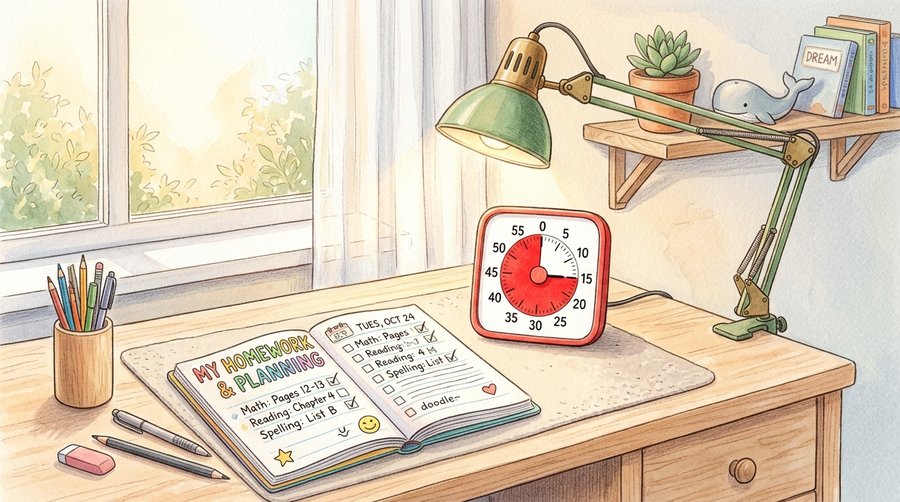
Struggling with homework initiation freeze and evening meltdowns? Discover how visual countdown timers externalize time blindness and bypass ADHD task paralysis using our 5-step occupational therapy routine.
Editorial Disclosure & Medical Scope: Sensory Kids Books shares neurodiversity-affirming, lived-experience insights and sensory-informed tools for parents, caregivers, and educators. This publication is for educational purposes only and does not constitute formal medical diagnosis, psychiatric evaluation, or clinical occupational therapy advice. Always consult a qualified pediatrician or licensed clinician for individual medical care. As an Amazon Associate, we earn from qualifying purchases through our independent affiliate links at zero extra cost to you.
⚡ Quick Takeaway & Summary for Parents: ADHD "Task Paralysis" (initiation freeze) is not laziness, procrastination, or defiance; it is a neurological bottleneck in the prefrontal cortex caused by a baseline dopamine deficit and profound "time blindness." When an ADHD child faces an open-ended assignment like "do your math worksheet," their brain cannot calculate the temporal boundary—it perceives the task as an infinite, un-survivable mountain. Standard smartphone timers fail because they invite high-dopamine notifications, while ticking mechanical timers trigger auditory stress and autonomic dysregulation. By externalizing time into a physical, disappearing colored disk with a silent 60-minute visual timer (such as the Time Timer MOD or Yunbaoit), and implementing our 5-Step "Dopamine Sprint" Protocol, you shrink the psychological barrier of entry, restore working memory bandwidth, and permanently eliminate evening homework battles.
You tell your child to open their backpack and complete three reading comprehension questions. Forty-five minutes later, you walk back into the room: the workbook is still blank, the pencil is untouched, and your child is either staring blankly into space, picking at their fingernails, or curled into a defensive ball on the floor.
"You've had almost an hour!" you say, feeling your blood pressure spike. "You could have finished this three times already!" But for a neurodivergent brain, staring at a blank page for forty-five minutes is not relaxing. It is an excruciating state of cognitive paralysis.
In psychology and pediatric occupational therapy, this phenomenon is called "Task Paralysis" or "Initiation Freeze." The child genuinely wants to start, but their executive functioning system cannot generate the initial spark of dopamine required to bridge the gap between intention and action. To break this freeze, you cannot rely on verbal nagging. You must alter how time is experienced in the physical environment.
The Neuroscience of ADHD Time Blindness: Why Numbers Lie
Dr. Russell Barkley, a leading clinical authority on ADHD, has repeatedly emphasized that ADHD is fundamentally a disorder of "time blindness." While neurotypical brains perceive time as a continuous river flowing from past to present to future, an ADHD brain operates in only two temporal zones: "NOW" and "NOT NOW."
1. Abstract Numbers Convey Zero Urgency: A digital clock displaying "5:17 PM" is purely conceptual. It requires working memory to calculate: "It is 5:17, dinner is at 6:00, so I have 43 minutes." For a child whose working memory is already depleted after seven hours of masking at school, this mental math produces cognitive overload.
2. The "Infinite Mountain" Illusion: Because they cannot visualize the end point, ten minutes of seated writing feels mathematically identical to four hours of torture. The limbic system perceives this perceived infinity as a threat, triggering a fight-or-flight freeze response.
3. Why Phone Timers and Ticking Clocks Backfire: Setting a timer on an iPad or smartphone puts your child one swipe away from YouTube or video games. Meanwhile, traditional mechanical kitchen timers emit a sharp "tick-tick-tick" at 60 decibels. In sensory-sensitive children, this repetitive auditory friction elevates cortisol and heart rate, transforming study time into an anxiety chamber.
The 5-Step Executive Function Protocol to Beat Task Paralysis
Here is the exact step-by-step protocol developed with pediatric occupational therapists to bypass initiation freeze using visual timers:
Step 1: The "5-Minute Dopamine Sprint" (The Micro-Demand). Never set a visual timer for 30 or 45 minutes when a child is frozen. That re-creates the mountain. Instead, turn the dial to exactly 5 minutes. Give one explicit instruction: "We are only working until the red disk disappears. When it is gone, you can stop completely, even if you only wrote two words." Shrinking the demand below the brain's threat threshold breaks inertia. In 85% of cases, once the dopamine kicks in and the pencil moves, the child voluntarily chooses to reset the timer and keep going.
Step 2: Peripheral Cockpit Placement (The 45-Degree Rule). Where you place the timer dictates its success. Do not put it directly next to their writing hand where they knock it over, and do not place it directly in front of their eyes where it creates obsessive clock-watching. Position the visual timer 18 inches away at a 45-degree angle in their upper peripheral field. This allows their brain to passively absorb the shrinking disk without interrupting eye-hand coordination.
Step 3: Pair the Timer with an Externalized Finish Line. A timer without a concrete milestone is an empty countdown. Before turning the dial, draw three quick checkboxes on a sticky note or place three cards from our Visual Daily Routine Pack next to the desk: 1. Name on paper, 2. Questions 1 & 2, 3. Put pencil in pouch. The brain needs to see both time shrinking AND tasks disappearing simultaneously.
Step 4: Strictly Silent Quartz Operation & Flashing Alarms. Ensure the timer has zero internal ticking. Furthermore, configure the alarm to either a single muted beep or a silent flashing red LED. Loud, continuous buzzers trigger sensory shock and send an autistic or PDA child straight into an explosive fight-or-flight meltdown right at the finish line.
Step 5: The 3-Minute "Buffer Bridge" Before Transitions. Sudden task stops trigger severe transition resistance. When using visual timers for screen time or play, set the timer for 3 minutes shorter than the actual limit. When the disk reaches zero, announce: "The red disk is gone; you have a 3-minute wrap-up bridge to save your game." This gives the dopamine receptors time to down-regulate smoothly.
1. Time Timer MOD (60-Minute Silent Timer): The Gold Standard

Invented over 30 years ago by a mother seeking a visual way for her daughter to understand time, Time Timer is the undisputed gold standard in classrooms, therapy clinics, and hospitals worldwide.
Why it works for ADHD: The patented high-contrast red disk vanishes smoothly as time elapses, providing an intuitive, spatial representation of remaining time. The MOD version features a rugged, non-slip charcoal silicone bumper that protects the internal quartz mechanism when knocked off desks or dropped by dysregulated kids. Its silent movement guarantees zero ticking noise, and the alert can be switched between a gentle beep or completely muted.
⭐ Time Timer MOD 60-Minute Visual Timer (Best Overall for ADHD & Autism)
True silent quartz movement. Protective silicone bumper case. Intuitive vanishing red disk that provides instant spatial time comprehension.
shopping_cart👉 Check Price for Time Timer MOD on Amazon (paid link)open_in_new
2. Yunbaoit 60-Minute Visual Timer: Best for Classroom & Silent Desks

If your child needs a visual timer for quiet classroom tests, library study, or shared home office spaces where any audible beep is forbidden, the Yunbaoit 60-Minute Timer is our top modern recommendation.
Key feature: In addition to standard high/low audible chimes, it features a unique "Silent Flashing LED" mode. When the colored disk reaches zero, an internal red LED light flashes discreetly on top of the dial, alerting your child visually without producing a single decibel of sound.
⭐ Yunbaoit 60-Minute Visual Countdown Timer (Best for Silent Classroom Study)
Silent flashing red LED alert mode for quiet classrooms. High-contrast disappearing disk with dual volume settings. Sturdy desk footprint.
shopping_cart👉 Check Price for Yunbaoit Timer on Amazon (paid link)open_in_new
3. Secura Magnetic Visual Timer: Best for Kitchen & Refrigerator Routines

Homework battles often start long before sitting down at the desk—they begin with after-school snacking, morning shoe-tying, and bathroom teeth-brushing. The Secura Magnetic Visual Timer is engineered specifically for whole-room family visibility.
Why parents choose it: Built with two heavy-duty rear magnets, it clamps securely to refrigerators, magnetic whiteboards, or metal filing cabinets. Its extra-large 7.5-inch diameter disk can be seen clearly from across the kitchen or living room, making it the perfect visual anchor for family chore and morning routines.
⭐ Secura Magnetic 60-Minute Visual Timer (Best for Refrigerator & Morning Routines)
Dual heavy-duty rear magnets for refrigerators and magnetic whiteboards. Extra-large high-visibility disk visible across entire rooms.
shopping_cart👉 Check Price for Secura Magnetic Timer on Amazon (paid link)open_in_new
4. Learning Resources Time Tracker: Best for Gamified Preschool & Early Elementary

For children ages 3 to 6 who find a disappearing colored disk too abstract, or children with Pathological Demand Avoidance (PDA) who feel pressured by shrinking disks, the Learning Resources Time Tracker operates on universal traffic light psychology.
How it works: It transitions through three distinct colored light stages: Green (plenty of time / go), Yellow (warning / wrap up your work), and Red (time is up). You can program custom warning intervals (e.g., green for 15 minutes, yellow for 5 minutes), providing a predictable visual buffer that completely eliminates transition meltdowns.
⭐ Learning Resources Time Tracker (Stoplight Timer) (Best for Early Learners & Transition Buffers)
3-color traffic light transitions (Green, Yellow, Red) with customizable audio cues. Perfect for gamified early learning and low-demand transitions.
shopping_cart👉 Check Price for Learning Resources Tracker on Amazon (paid link)open_in_new
Digital Tools to Pair with Your Visual Timer
A visual timer provides the engine of time comprehension, but executive dysfunction also requires an external navigational map. Pair your desk timer with our specialized neurodivergent printable kits:
🎒 The ADHD & PDA Anti-Planner ($8.99 Instant PDF)
Built specifically for brains that rebel against rigid schedules. Features dopamine menus, initiation checklists, sprint trackers, and meltdown recovery maps designed to turn time tracking into an empowering game.
👉 Get The ADHD & PDA Anti-Planner in Our Shop
🎒 Autism & ADHD Visual Daily Routine Pack ($7.99 / $14.99 Bundle)
Over 80+ color-coded visual cards and sequence strips. Clip the "5-Min Timer" card straight onto your child's after-school homework strip so they know exactly what to expect before opening a book.
👉 Download the Visual Daily Routine Pack
🎒 504 Plan Master Toolkit for ADHD ($7.99 Instant Download)
Did you know visual timers can be written into your child's legal school accommodations? Get pre-written, lawyer-vetted 504 and IEP clauses for silent visual timers, extended time, and chunked testing sprints.
👉 Get the 504 Plan Master Toolkit
Free Interactive Tools on Sensory Kids Books
You can customize your child's homework schedule and sensory accommodations right now with our free web generators:
• Generate a printable visual daily schedule with our free Visual Daily Routine Generator to map out homework sprints and reward breaks.
• Prevent homework fatigue by creating a customized sensory warm-up using our Sensory Diet Schedule Generator (e.g., 5 minutes of proprioceptive heavy work before starting the timer).
• Preparing for an annual evaluation? Generate data-driven IEP accommodation goals with our free IEP SMART Goal Generator for time management and self-regulation.
Related Guides & Resources
• Looking for an in-depth hardware comparison of all 4 models? Read our buyer's guide: Best Visual Timers for Kids with ADHD: Features Parents Should Compare to see detailed specs, durability tests, and battery comparisons.
• Need to set up the rest of your child's workspace? Check out: How to Build a Low-Distraction Homework Station for ADHD Kids for sensory seating, desktop carrels, and non-flicker lighting.
• Struggling with zero motivation? Learn how to replenish dopamine first: How to Build an ADHD Dopamine Menu to Beat Task Paralysis to create an appetite for homework initiation.
Final Verdict: Make Time Tangible, Remove the Shame
When an ADHD child cannot start their homework, shame and frustration will only deepen their neurological freeze. By introducing a silent visual timer like the Time Timer MOD or Yunbaoit, you take time out of the abstract realm of numbers and place it firmly into the physical world. Start tonight with a simple 5-Minute Dopamine Sprint—you will be amazed at how quickly resistance melts away when time is finally visible, predictable, and finite.
 Instant PDF
The ADHD & PDA Anti-Planner
An Undated, Low-Demand Gamified Planner & Focus Journal for Neurodivergent Minds
Recommended Sensory Products
Carefully curated products for a sensory-friendly environment.
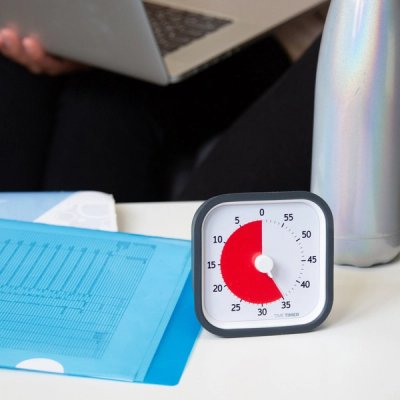
Time Timer MOD (60-Minute Silent Timer)
Best Overall for ADHD
The clinical gold standard visual timer featuring a vanishing red disk, protective silicone bumper case, and completely silent quartz movement.
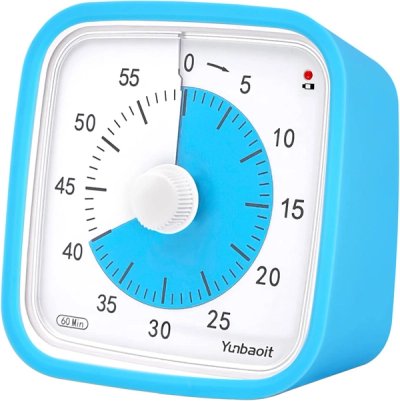
Yunbaoit 60-Minute Visual Countdown Timer
Best for Silent Classroom Study
Modern desk timer with high-contrast colored disk, dual volume controls, and a silent flashing red LED alert mode for quiet rooms.
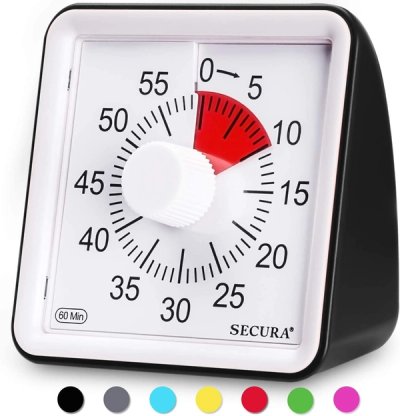
Secura Magnetic 60-Minute Visual Timer
Best for Kitchen & Refrigerator
Heavy-duty dual rear magnets attach securely to refrigerators and magnetic whiteboards. Large 7.5-inch disk visible across entire rooms.
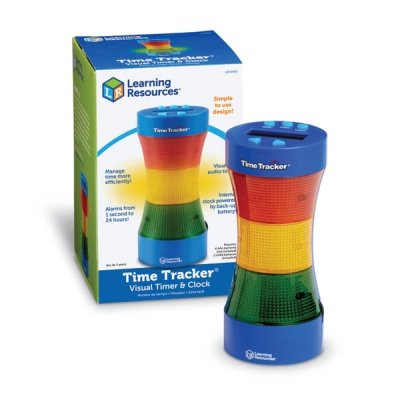
Learning Resources Time Tracker (Stoplight)
Best for Gamified Transitions
3-color traffic light transitions (Green, Yellow, Red) with customizable audio cues. Perfect for early learners and transition buffers.
📚 Evidence-Based Sources & Citations
Peer-reviewed literature, clinical frameworks, and foundational neurodiversity resources referenced in this guide.
- Executive Functioning and Time Perception in Children with Attention-Deficit/Hyperactivity Disorder — Journal of Attention Disorders (Barkley et al.)(2021)View Sourceopen_in_new
- Occupational Therapy Practice Guidelines for Children and Youth with Challenges in Sensory Processing and Executive Function — American Occupational Therapy Association (AOTA)(2020)View Sourceopen_in_new
- Externalizing Working Memory and Temporal Cues to Support Academic Task Initiation — Child Development & Neuropsychology Review(2022)View Sourceopen_in_new
- Managing Homework Frustration and Task Paralysis in Neurodivergent Students — Child Mind Institute(2023)View Sourceopen_in_new
Join the Conversation
Get our monthly guide on sensory-aware parenting and neuro-inclusive home design delivered straight to your sanctuary.
Respecting your inbox and your peace of mind.
Leave a Reply
Your email address will not be published. Required fields are marked *