The Sunday Evening Launchpad: 4 Stress-Free Family Systems to End the 'Sunday Scaries' and Prep for School
Tired of chaotic Sunday night battles and frantic Monday mornings? Discover 4 practical, low-demand family systems—from 5-day wardrobe staging to an entryway launchpad—that eliminate the "Sunday Scaries" and set kids up for a peaceful school week.
Editorial Disclosure & Medical Scope: Sensory Kids Books shares neurodiversity-affirming, lived-experience insights and sensory-informed tools for parents, caregivers, and educators. This publication is for educational purposes only and does not constitute formal medical diagnosis, psychiatric evaluation, or clinical occupational therapy advice. Always consult a qualified pediatrician or licensed clinician for individual medical care. As an Amazon Associate, we earn from qualifying purchases through our independent affiliate links at zero extra cost to you.
⚡ Quick Takeaway & Summary for Parents:
The "Sunday Scaries" are rarely about bad attitudes—they are caused by the immense mental friction of transitioning from unstructured weekend freedom straight into strict weekday demands. By treating Sunday evening like a "pre-flight launchpad" with 4 simple physical systems—staging 5 outfits in hanging shelves, parking backpacks at an entryway station, serving a zero-effort supper, and providing a 45-minute sensory soft landing—you eliminate 90% of Monday morning battles before the alarm even rings.
Why Sunday Nights Spark Household Meltdowns
It happens every Sunday around 5:30 PM. The relaxed, low-key rhythm of the weekend begins to dissolve, and an unspoken tension fills the house. Homework that was pushed off on Friday suddenly resurfaces. Parents start frantically searching for clean uniforms and missing gym sneakers. Meanwhile, kids become restless, argumentative, or completely resistant to the simplest requests.
As a software architect and a parent of neurodivergent kids, I view household stress through the lens of systems engineering. In computing, if you abruptly switch a server from low-power idle mode to peak production load with zero staging buffer, the entire process crashes. Human nervous systems behave the exact same way.
When children experience what adults call the "Sunday Scaries," their brains are grappling with invisible cognitive load: the sudden realization that predictable play is ending, early alarms are returning, sensory overwhelm is looming, and dozens of choices must be made before breakfast. The solution is not harsher rules or earlier bedtime demands. The solution is removing friction from the physical environment.
The 4 Sunday Evening Launchpad Systems
A launchpad is not a rigid military drill. It is an organized physical workflow that offloads executive function demands onto your home environment. Here are the 4 practical systems we use to transform chaotic Sunday evenings into a peaceful springboard for the school week.
🚀 Launchpad System #1: The 5-Shelf "Outfits-for-the-Week" Closet Staging Station (Physical Wardrobe Batching)
Deciding what to wear on a rushed Monday morning is one of the highest friction points for sensitive kids. By selecting and sorting all 5 school outfits on Sunday afternoon into a dedicated hanging organizer, morning dressing becomes an automated grab-and-go routine.
For children with sensory tactile sensitivities, clothing battles can derail an entire morning. Tags scratch, seams dig into toes, or a favorite shirt turns out to be wet in the laundry basket. Forcing those negotiations at 7:15 AM creates immediate nervous system dysregulation.
Every Sunday afternoon at 4:00 PM, we do the "Five-Minute Closet Batch." We use a simple 5-shelf hanging organizer labeled Monday through Friday. My child picks 5 complete outfits—shirt, comfortable soft bottoms, seamless socks, and underwear. Everything is inspected for comfort when emotions are calm and there is zero time pressure.

⭐ Recommended Tool: Hanging Weekly 5-Shelf Closet Organizer with Days of the Week (Best for Morning Autonomy)
Features 5 sturdy reinforced compartments labeled Monday through Friday. Lets kids independently stage their entire weekly wardrobe on Sunday afternoon without morning indecision.
shopping_cart👉 Check Price on Amazon (paid link)open_in_new
Once the outfits are in the hanging shelves, wardrobe decisions for the entire week are officially closed. Monday morning requires exactly zero brainpower: open the closet, pull shelf #1, and put it on.
🚀 Launchpad System #2: The Dedicated Entryway Backpack & Launchpad Station (Visual Exit Runway)
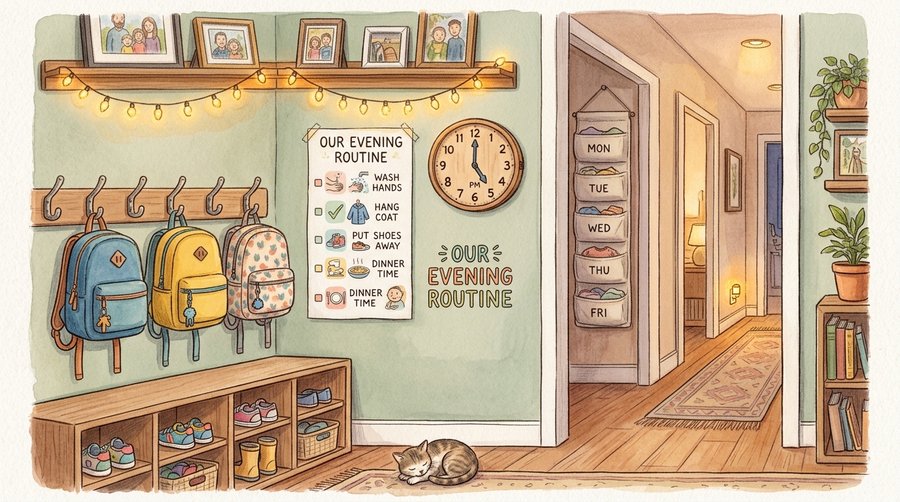
Searching for missing backpacks, permission slips, or school shoes at 7:45 AM creates peak adrenaline. A designated entryway station with child-height wall hooks and clear pocket organizers ensures everything exits and enters through one single point.
If school items are scattered across bedrooms, couches, and kitchen counters, your brain has to run a search query every single morning. That search friction triggers task paralysis and parental irritation before anyone even leaves the driveway.
Create a physical "Landing Zone" directly beside your main exit door. In our entryway, every child has a heavy-duty hook hung at their eye level, a labeled basket on the floor for shoes, and an over-the-door clear pocket organizer for quick-grab items like library cards, transit passes, gloves, and sunglasses.

⭐ Recommended Tool: Over-the-Door Clear Pocket Hanging Organizer & Heavy-Duty Wall Hooks (Best for Entryway Clutter)
Transparent durable pockets allow kids and parents to see essential supplies instantly. Child-height hanging hooks keep backpacks, coats, and lunch bags off the floor and ready for departure.
shopping_cart👉 Check Price on Amazon (paid link)open_in_new
On Sunday at 4:30 PM, we run the "10-Minute Backpack Audit." Backpacks are unzipped, old lunch containers and permission slips are pulled, folders are packed, and water bottles are washed and placed in the side pocket. When the bag is zipped and hung on the hook, the child’s brain registers that school prep is 100% complete.
🚀 Launchpad System #3: The "Zero-Demand" Sunday Supper & Visual Evening Timeline (Predictable Pacing)
Sunday night is not the time for elaborate, multi-course culinary experiments that delay dinner until 7:30 PM. An early, low-effort comfort meal paired with a visual countdown timer gives children a spacious, stress-free evening runway.
When dinner runs late on Sunday, everything gets compressed. Bath time becomes a race, bedtime stories get truncated, and parents become tense watching the clock. Kids instinctively sense that tension and mirror it with heightened resistance.
We designate Sunday nights as "Zero-Demand Supper." Whether it is a slow-cooker chili, a build-your-own taco bar, or simple warm soup and grilled sandwiches, dinner is served promptly at 5:30 PM. Alongside dinner, we place a 60-minute visual timer on the counter.

⭐ Recommended Tool: Time Timer MOD 60-Minute Visual Countdown Timer (Best for Visual Time Awareness)
A silent, disappearing colored disk that shows time passing visually without loud ticking. Perfect for giving children a clear, non-verbal sense of how much relaxing evening runway remains.
shopping_cart👉 Check Price on Amazon (paid link)open_in_new
A visual timer completely removes the need for parents to repeatedly nag: "Hurry up, you only have ten minutes!" When children see the colored disk shrinking naturally, time becomes concrete rather than an arbitrary adult command.
📋 Autism & ADHD Visual Daily Routine Pack ($7.99 / $14.99)
Need customizable routine cards and visual timeline charts for evening transitions and morning departures? Our printable routine bundle includes over 120 visual icon cards, first-then boards, and weekly checklists designed specifically for neurodivergent households.
👉 Get the Visual Daily Routine Pack on Sensory Kids Books
🚀 Launchpad System #4: The 45-Minute Sensory "Soft Landing" Bedtime Buffer (Downshifting the Nervous System)
You cannot push a child straight from bright screens and high-energy family play into deep sleep. A 45-minute sensory buffer with lowered lighting, warm white noise, and gentle co-reading creates a physiological bridge to rest.
The Sunday scaries often peak the moment a child’s head hits the pillow. In the dark and quiet, worries about Monday morning tests, social pressures, or schedule changes amplify. If the bedroom environment is cold or overly stimulating, falling asleep becomes an agonizing struggle.
At 7:00 PM, our home enters "Sunset Mode." All harsh overhead lights are switched off, replaced by warm amber bedside lamps or fairy lights. We turn on a dedicated white noise machine to mask outside street noise and provide a steady auditory blanket.

⭐ Recommended Tool: Dreamegg D1 White Noise Sound Machine & Bedside Light (Best for Bedtime Sensory Calm)
Offers 24 non-looping soothing sounds (fan, rain, ocean, white noise) with a built-in warm amber nightlight. Masks sudden noises and anchors the bedroom as a safe, calming sanctuary for restorative sleep.
shopping_cart👉 Check Price on Amazon (paid link)open_in_new
During this 45-minute window, we don’t discuss tomorrow’s schedule or homework tasks. We read a gentle chapter book together, do gentle deep-pressure tuck-ins with cozy blankets, or listen to an audio story. This tells the nervous system: "You are safe, everything is prepared, and there is nothing you need to solve right now."
📋 The ADHD & PDA Anti-Planner ($8.99)
Designed for kids, teens, and parents who freeze under traditional rigid calendars. Features low-demand visual trackers, emotion check-in dials, and flexible menu-style templates to manage weekly transitions without guilt or paralysis.
👉 Explore The Anti-Planner in Our Shop
Sunday Evening Launchpad Checklist for Parents
To help you implement this system smoothly without creating extra weekend chores, here is our quick reference timeline. Pin this to your refrigerator or save it to your phone:
• 4:00 PM — Wardrobe Batching: Pull 5 complete outfits into the hanging closet organizer. Check socks, tags, and favorites so zero wardrobe decisions remain.
• 4:30 PM — Backpack & Entryway Audit: Empty lunch bags, sign papers, repack folders, fill water bottles, and hang backpacks on eye-level hooks by the door.
• 5:30 PM — Zero-Demand Supper: Serve a simple comfort meal with zero culinary pressure. Set the visual timer so everyone sees the evening unfold.
• 6:45 PM — Warm Bath & Pajamas: Warm water and cozy clothes signal the body to release daytime tension.
• 7:15 PM — Sensory Sunset Mode: Switch off overhead glare, turn on warm amber lighting and white noise, and enjoy 45 minutes of gentle reading or connection.
Free Interactive Tools on Sensory Kids Books
You don’t have to reinvent daily routines from scratch. Use our free web tools to create customized visual schedules and sensory pacing tailored to your child:
• Generate a printable visual morning and evening routine with our free Visual Daily Routine Schedule Generator to provide visual clarity for the week ahead.
• Balance your child’s weekly calming inputs using our interactive Sensory Diet Schedule Generator designed for sensory-seeking and sensitive kids.
Final Thoughts: Building Safety Through Predictability
A calm Monday morning is never built on Monday morning. It is engineered the evening before, not through rigid perfectionism, but through gentle, low-friction physical cues.
When your home holds the answers to where the shoes are, what will be worn, and when the day will end, your child does not have to spend precious emotional energy worrying about the unknown. Start with just one launchpad habit this coming Sunday—whether it is the hanging outfit organizer or the 4:30 PM backpack reset—and watch how much lighter your entire household feels when the Monday alarm rings.
 Instant PDF
The After-School Decompression Menu
A Low-Demand Visual Routine, Sensory Snack Pairing Matrix & Meltdown Reset Guide for Autistic & ADHD Kids
Recommended Sensory Products
Carefully curated products for a sensory-friendly environment.

Weighted Lap Pad
BEST FOR FOCUS
Providing 5lbs of gentle pressure to help children stay grounded during long reading sessions.

Dimmable Warm LED
SENSORY FRIENDLY
Flicker-free technology with adjustable color temperatures to prevent eye strain.
📚 Evidence-Based Sources & Citations
Peer-reviewed literature, clinical frameworks, and foundational neurodiversity resources referenced in this guide.
- Occupational Therapy Practice Framework: Domain and Process (4th Edition) — American Occupational Therapy Association (AOTA)(2020)View Sourceopen_in_new
- The Polyvagal Theory: Neurophysiological Foundations of Emotions, Attachment, Communication, and Self-Regulation — Dr. Stephen W. Porges, PhD(2011)View Sourceopen_in_new
- Understanding Pathological Demand Avoidance (PDA): Identifying Needs & Low-Demand Approaches — PDA Society UK(2023)View Sourceopen_in_new
- Sensory Processing Issues Explained: Supporting Children with Sensory Sensitivities — Child Mind Institute(2024)View Sourceopen_in_new
Join the Conversation
Get our monthly guide on sensory-aware parenting and neuro-inclusive home design delivered straight to your sanctuary.
Respecting your inbox and your peace of mind.
Leave a Reply
Your email address will not be published. Required fields are marked *