ADHD Organization Tips for Kids: The Zero-Friction System That Actually Works (+ Age-by-Age Roadmap)
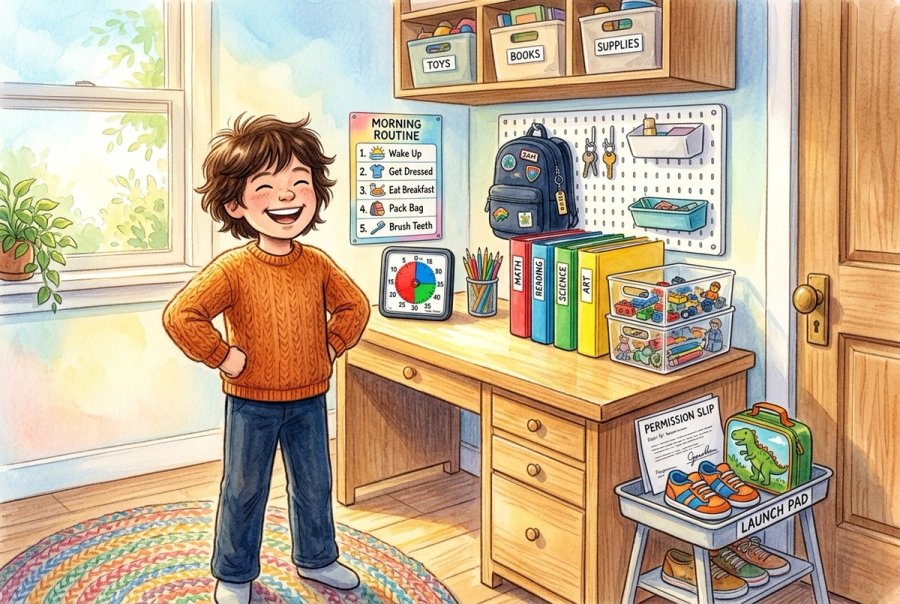
Traditional organizing advice fails ADHD kids because it demands the exact executive functions their brains struggle with. Here's the zero-friction, visual-first architecture that actually works — from a systems architect who parents an ADHD child.
I want you to picture a Monday morning in my house two years ago.
My daughter is standing in the middle of her bedroom, surrounded by a tornado of school papers, three half-finished art projects, yesterday's socks, a backpack that looks like it's been through a garbage disposal, and a homework folder that contains precisely zero homework. She's been staring at the disaster for eleven minutes. Not because she doesn't care. Not because she's lazy. Because her executive function system literally cannot figure out where to start.
I'm in the hallway, desperately trying not to say "just clean it up" for the four hundredth time — because I know those words are as useful as telling someone with a broken leg to just walk it off.
If that scene sounds painfully familiar, you're in the right place.
As a systems architect who spends my professional life debugging complex network failures, I eventually realized something: my daughter's organizational challenges weren't a character flaw. They were a systems design problem. And once I started treating them that way — designing around her ADHD brain instead of fighting against it — everything changed.
In this guide, I'm going to share everything that actually worked: the neuroscience behind why traditional organization fails ADHD kids, the zero-friction systems we built together, and the specific tools that turned daily chaos into calm, self-directed confidence.
Why Traditional Organizing Fails the ADHD Brain
Before we fix anything, we need to understand what we're actually dealing with. ADHD isn't a deficit of attention — it's a deficit of executive function. And organization lives entirely in executive function territory.
The Executive Function Bottleneck
Dr. Russell Barkley's research identifies six key executive functions that ADHD impairs: working memory, emotional regulation, task initiation, planning and prioritization, time awareness, and self-monitoring. Every single one of these is required for basic organization.
When you tell an ADHD child to "clean your room," you're actually asking them to: (1) survey the entire room, (2) mentally categorize every item, (3) prioritize which category to tackle first, (4) remember where each item belongs, (5) sustain focus through the entire process, and (6) monitor their own progress. That's six executive function demands in a single instruction. For a child whose working memory can hold maybe two items at a time, it's like asking them to juggle while riding a unicycle on a tightrope.
"Out of Sight = Out of Existence"
Here's something most organizing advice gets catastrophically wrong: it tells you to "put everything away in drawers and closets." For neurotypical brains, this works beautifully. For ADHD brains, items stored in closed containers literally cease to exist in working memory.
This is why your child swears they don't own a jacket — even though three jackets are hanging in their closet. It's why homework vanishes into the backpack black hole. It's why they wear the same two shirts on rotation while a drawer full of clothes sits untouched. The neuroscience term is "object permanence challenges," and it fundamentally changes how we need to design organizational systems.
The 3-Step Fatigue Rule
Every organizational system has a "friction cost" — the number of steps required to put something away. Neurotypical kids can handle 3-4 steps (open closet → pull out bin → put item in bin → close closet). ADHD kids have a maximum friction tolerance of about 1-2 steps before the system collapses. If putting something away requires opening a door, lifting a lid, or remembering which drawer it goes in, it won't happen. Period.
This is the golden design principle we'll use throughout this entire guide: if it takes more than one step, redesign it.
The Zero-Friction Architecture: Design Principles That Actually Work
Now that we understand the neuroscience, let's build systems that work with the ADHD brain instead of against it.
Open Baskets Over Drawers — Always
Replace every closed drawer and lidded container with open-top baskets, clear acrylic bins, or wall-mounted cubbies. Your child needs to see everything at a glance. Label each basket with a picture icon (not just text) for younger kids. The visual label triggers recognition memory, which is intact in ADHD — unlike recall memory, which is impaired.
Zero-cost hack: Cut the lids off shoe boxes and label them with hand-drawn icons. Instant open storage.
Wall Pegboards Over Hangers
Hanging a jacket on a hanger inside a closet = 4 steps (walk to closet, open door, find hanger, hang jacket). A wall-mounted pegboard by the front door = 1 step (throw jacket on hook). Install a pegboard at your child's height with large, labeled hooks for backpack, jacket, hat, and keys.
The "Launch Pad" System
This was the single biggest game-changer in our household. A Launch Pad is a dedicated tray, shelf, or bench positioned right next to the front door. Every evening, your child stages everything they'll need tomorrow morning: backpack, shoes, lunchbox, permission slips, water bottle.
The rule is simple: if it's not on the Launch Pad by 8 PM, it doesn't exist tomorrow. This externalizes the working memory burden completely. Your child doesn't need to remember anything — they just need to grab and go.
ADHD Bedroom Organization: Calming the Sensory Storm
An ADHD child's bedroom is ground zero for organizational chaos. But it's also the space where we can make the most dramatic impact.
The 4-Zone Bedroom Blueprint
Divide the bedroom into four clearly defined zones, each with a visual boundary (a different colored rug, tape line on the floor, or wall banner):
Sleep Zone: Bed only. No toys, no screens, no clutter. This area is sacred for rest.
Work Zone: Desk, homework supplies, visual timer. Face the desk toward a blank wall to reduce visual distractions.
Play Zone: Open-top toy bins with picture labels. Toy rotation system (only 4-5 categories accessible at a time; rotate weekly).
Launchpad Zone: Near the door. Tomorrow's outfit laid out on a hook. Backpack staged and ready.
This spatial architecture gives the ADHD brain clear boundaries. Instead of one overwhelming room, they now have four simple micro-environments, each with a single purpose.
The "Doom Box" Rescue System
Every ADHD household needs a Doom Box — a large, open-top bin where miscellaneous clutter gets triaged when the bedroom floor becomes unnavigable. The rule: throw everything on the floor into the Doom Box. Sort it later (or during a scheduled 5-minute "Doom Box Sprint" on Saturday mornings). This prevents the all-or-nothing perfectionism trap that causes most ADHD kids to freeze and give up entirely.
The Clear Acrylic Strategy
Replace opaque bins and drawers with clear, see-through containers wherever possible. Clear acrylic shoe boxes for small toys. Clear pencil cups instead of zippered pouches. Clear hanging shoe organizers on the closet door for accessories. If your child can see the contents without opening anything, they'll actually use the system.
School & Backpack Mastery: Ending the Lost Homework Epidemic
If your child's backpack is a black hole where homework and permission slips go to die, these strategies will change your life.
The Single "Active Folder" System
Forget the seven-folder color-coded accordion system. ADHD kids need exactly ONE two-pocket folder labeled "TO DO" on the left and "DONE" on the right. Every paper that comes home goes in the left pocket. Every completed assignment goes in the right pocket. That's it. One decision point, not seven.
The beauty of this system is that it eliminates the most common failure point: filing. ADHD kids don't file. They stuff. The Active Folder turns stuffing into a functional system.
The Color-Coded Subject System
Assign each school subject a color: Math = Red, Reading = Blue, Science = Green, Social Studies = Yellow. Apply this color consistently everywhere: the notebook cover, the folder tab, the textbook cover, and even the section of the backpack. This creates visual muscle memory — your child doesn't need to read labels or remember which folder goes where. They just match colors.
The 5-Minute Nightly Backpack Reset
Every night before bed, set a visual timer for 5 minutes and do the Backpack Reset together:
Step 1: Dump everything out of the backpack onto the table.
Step 2: Sort into three piles — Keep, Trash, Give to Parent (permission slips, event notices).
Step 3: Repack only what's needed for tomorrow.
Step 4: Place backpack on the Launch Pad.
This ritual takes less than 5 minutes and prevents 90% of the "I forgot my homework" emergencies.
Beating Task Paralysis: How to Clean Without Meltdowns
The hardest part of organization for ADHD kids isn't the organizing itself — it's starting. Task paralysis is real, and it's neurological, not behavioral.
The Power of Body Doubling
Body doubling means simply being physically present while your child works. You don't need to help, instruct, or supervise. Just sit in the room. Read a book. Fold laundry. Your calm physical presence provides external regulation that the ADHD brain can't generate internally.
This is co-regulation in action, and research consistently shows it's one of the most effective tools for overcoming task initiation difficulties. Never say "I need you to clean your room." Instead, say: "I'm going to sit in here and fold some towels. You can start whenever you're ready." Declarative, not imperative.
The 5-Item Sprint
When your child is frozen in front of a messy room, don't say "clean your room." Say: "Can you find 5 things that go in the trash?" That's it. Five items. Then celebrate. Then ask for 5 more. This breaks the infinite task into tiny, dopamine-rewarding micro-wins.
The "Junebugging" Method
Named after the way junebug beetles fly in concentric circles, this OT-grounded technique prevents the classic ADHD pattern of starting in one corner, getting distracted, wandering to another corner, and abandoning the task. Instead: stand in the center of the room, spin slowly, and pick up the nearest item. Put it away. Return to center. Pick up the next nearest item. The circular pattern prevents wandering and creates a dopamine-triggering sense of visible progress as the circle expands.
Visual Timers & Time Blindness Tools
ADHD brains experience time in two modes: NOW and NOT NOW. There is no concept of "in 20 minutes" or "by Friday." This is called time blindness, and it's one of the most disabling aspects of ADHD that rarely gets addressed in organizational advice.
Why Visual Disk Timers Win
Digital timers display abstract numbers that mean nothing to an ADHD brain. Visual analog timers (like the Time Timer) display a colored disk that physically shrinks as time passes. Your child can SEE time disappearing. This makes the invisible visible and is backed by occupational therapy research as one of the most effective ADHD accommodations.
Building a Visual Morning Routine Strip
Create a vertical strip of picture cards showing each morning task in order: Wake Up → Get Dressed → Eat Breakfast → Brush Teeth → Pack Bag → Shoes On → Launch Pad Check. Laminate it and attach Velcro checkmarks your child can physically move as they complete each step. This externalizes the entire sequence from working memory onto a physical surface.
For focus breaks between tasks, try building an ADHD Dopamine Menu — a visual buffet of quick dopamine-boosting activities your child can choose from when they need a 5-minute reset.
Age-by-Age ADHD Organization Roadmap
Not all organizational strategies work for every age. Here's a stage-appropriate progression:
Early Elementary (Ages 5-7): Visual Icons & Low-Drop Bins
At this age, everything should be picture-based, not text-based. Use photo labels on bins, color-coded hooks at their height, and a simple 3-step morning routine strip. The goal is building habit muscle memory, not independence.
Upper Elementary (Ages 8-11): Color Coding & Launch Pads
This is the golden window for installing the Launch Pad, the Active Folder, and the color-coded subject system. Start the nightly Backpack Reset as a parent-child co-regulation activity. Introduce the visual timer for homework blocks (15 minutes on, 5 minutes off).
Middle & High School (Ages 12-18): Digital Systems & Planner Independence
Teens need hybrid systems: a physical Launch Pad combined with digital tools. Help them set up a Google Calendar with color-coded class blocks. Teach the "2-minute rule" (if it takes less than 2 minutes, do it now). Address digital clutter: phone app folders, browser tab management, and Google Drive folder structure.
If your teen struggles with traditional planners, check out our guide on why traditional planners fail ADHD kids and what works instead.
Best Visual Organization Tools (Architect-Approved)
Here are the specific tools I've personally tested and recommend for ADHD families:
🔵 Visual Countdown Timer: shopping_cartCheck Price on Amazonopen_in_new — The single most important ADHD tool. A colored disk that shrinks as time passes, making invisible time visible.
🟢 Clear Acrylic Storage Bins: shopping_cartCheck Price on Amazonopen_in_new — See-through containers that solve the "out of sight, out of mind" problem completely.
🟡 Wall Pegboard Organizer: shopping_cartCheck Price on Amazonopen_in_new — One-step jacket/backpack storage that replaces multi-step closet systems.
🔴 Visual Daily Routine Chart: shopping_cartCheck Price on Amazonopen_in_new — Magnetic or Velcro picture-based morning/evening routine strips.
🟣 Color-Coded School Folders: shopping_cartCheck Price on Amazonopen_in_new — Matching notebook + folder sets in red, blue, green, and yellow for subject color coding.
IEP & 504 Organizational Accommodations
If your child has an IEP or 504 plan, here are specific organizational accommodations you can request using copy-paste wording:
"Student will be provided with a second set of textbooks to keep at home to eliminate the need to transport materials between school and home."
"Student will receive a written daily agenda or assignment checklist from each teacher, provided at the start of each class."
"Student will be permitted to use a single organizational folder (two-pocket system) across all classes in lieu of a multi-binder system."
"Student will be given 3-5 minutes at the end of each class period to organize materials and pack their backpack with teacher supervision."
Print these accommodations and bring them to your next IEP/504 meeting. Teachers are generally very receptive when you provide specific, actionable language rather than vague requests.
Your Next Step
Organization for ADHD kids isn't about willpower, discipline, or "trying harder." It's about designing systems that work with the way their beautiful, brilliant brains actually function.
Every strategy in this guide follows the same principle: externalize the invisible. Make time visible with analog timers. Make items visible with clear bins. Make routines visible with picture strips. Make tomorrow visible with the Launch Pad.
If you want a complete, structured workbook with all of these systems built into interactive worksheets — including the 4-Zone Bedroom Blueprint, the Doom Box Rescue System, the Junebugging cleaning method, the Backpack Black Hole Spatial Map, and tear-out visual tools — check out The ADHD Organization Workbook for Kids & Teens in our shop.
And if you need free interactive tools right now, try our Sensory Diet Generator and IEP Goal Generator — both free, no signup required.
You're not failing. You're parenting a brain that runs on a different operating system. And now you have the architecture to match.
 Instant PDF
The Adhd And Pda Anti Planner
An Undated, Low-Demand Gamified Planner & Focus Journal for Neurodivergent Minds
Quick Answers for Parents & Educators
Recommended Sensory Products
Carefully curated products for a sensory-friendly environment.
Visual Countdown Timer for Kids
ADHD Essential
A colored disk that shrinks as time passes, making invisible time visible. The #1 OT-recommended tool for time blindness.
Clear Acrylic Storage Bins
Organization Essential
See-through bins that solve 'out of sight, out of mind.' Perfect for toys, school supplies, and bedroom zones.
Wall Pegboard Organizer
Zero-Friction
One-step backpack and jacket storage. Mount at child height for independent use.
Join the Conversation
Get our monthly guide on sensory-aware parenting and neuro-inclusive home design delivered straight to your sanctuary.
Respecting your inbox and your peace of mind.
Discussion (0)
No comments yet. Be the first to share your thoughts!
Leave a Reply
Your email address will not be published. Required fields are marked *