Anger Management Activities for Kids: 25+ Somatic, Visual & Neuro-Affirming Coping Tools
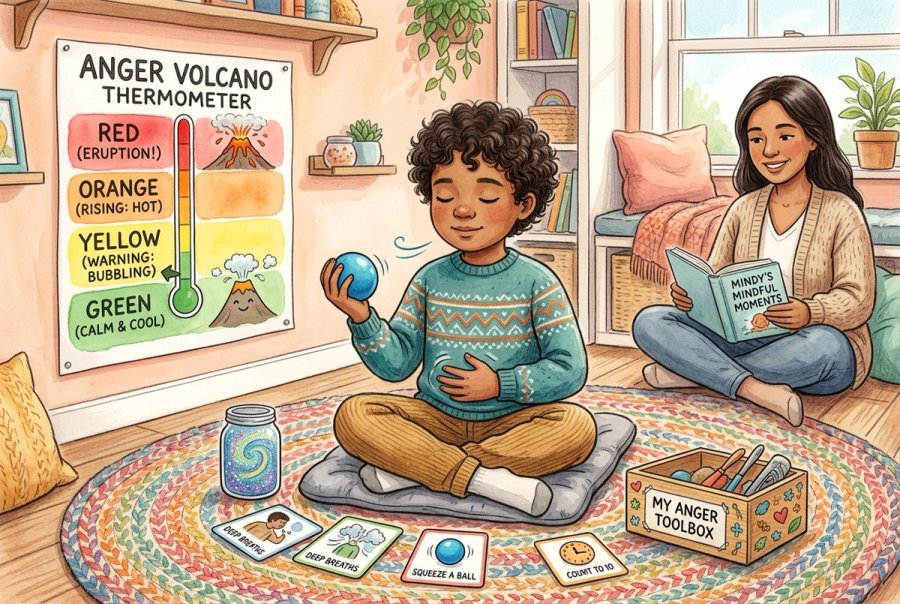
Traditional advice like 'take deep breaths' or 'count to ten' fails angry kids because their rational brain is offline. Here are 25+ somatic and visual activities that work with nervous system biology to cool down explosive meltdowns.
It was 5:15 PM on a rainy Tuesday, and my living room looked like a seismic event had just taken place.
My seven-year-old was lying face down on the rug, screaming so hard her face was crimson, kicking the sofa leg with rhythmically violent thuds. A glass of apple juice had just shattered against the kitchen baseboard. The triggering crime that brought down the entire house? Her blue socks were in the wash, and I had handed her the green pair.
I did what every parenting book from the 1990s told me to do: I knelt down, lowered my voice to a calm monotone, and said: "Take a deep breath and use your words. Counting to ten will help." The result? A shrieking roar, a thrown shoe that barely missed my forehead, and another forty-five minutes of uncontainable volcanic rage.
Standing in that living room, feeling completely depleted, embarrassed, and terrified that I was failing as a father, I knew traditional parenting wisdom was useless here. In my professional life as a systems architect, when a server crashes, you don't scream at the processor to behave. You inspect the bottleneck, find the buffer overflow, and redesign the load capacity. Our children's emotional explosions operate on the exact same mechanical physics.
Childhood anger is rarely defiance or bad attitude. It is a biological emergency broadcast from a nervous system that has run out of bandwidth. In this definitive guide, we are moving far beyond cliché breathing advice. I'm going to share 25+ somatic, visual, and neurodivergent-affirming anger management activities that actually work with the biology of the brain to de-escalate rage and restore peace to your home.
Understanding Childhood Anger: Why 'Just Calm Down' Never Works
Before we introduce a single activity, we have to demystify what is happening inside your child's skull during an explosive rage episode.
The Architecture of a 'Flipped Lid'
Dr. Dan Siegel developed the brilliant 'Hand-Brain Model' that explains this perfectly. The brain consists of two essential operating levels: the Upstairs Brain (prefrontal cortex) responsible for logic, empathy, problem-solving, and impulse control, and the Downstairs Brain (amygdala and limbic system) responsible for raw survival instincts—fight, flight, freeze, or fawn.
When an anger trigger occurs, cortisol and adrenaline surge through the bloodstream. The amygdala sounds a biological siren, and the connection between the Upstairs Brain and Downstairs Brain physically disconnects. We call this 'flipping the lid.' In that moment, your child literally cannot access logic, cannot process complex language, and cannot 'decide' to be reasonable. Asking an explosive child to 'think about their choices' is neurologically equivalent to asking a computer to run software while its power cord is unplugged.
Emotional Regulation vs. Anger Management: The Critical Shift
Traditional 'anger management' treats anger as an unacceptable behavior that must be stamped out, managed, or punished. This approach backfires because anger is a natural, healthy survival emotion designed to protect boundaries.
Neuro-affirming 'emotional regulation,' by contrast, teaches children that anger is welcome information, but aggressive destruction is unsafe. Our goal is never to stop a child from feeling angry—it is to expand their nervous system's capacity to process big somatic energy safely.
The Anger Iceberg: What Lurks Beneath
Anger is almost always a secondary emotion. It is the visible tip of the iceberg rising above the waterline. Below the surface sits an overwhelming mass of primary, vulnerable emotions: sensory overload, physical exhaustion, hunger, shame, anxiety, embarrassment, or fear.
When an autistic child or a child with ADHD explodes over a transition, the rage is rarely about the activity itself—it is the tip of an iceberg made of auditory exhaustion, unexpected schedule shifts, or interoceptive hunger cues that their brain couldn't decode in time.
Tantrum vs. Meltdown: Why ADHD and Autistic Kids Rage Differently
One of the most destructive mistakes parents make is treating every explosive episode as a willful temper tantrum. In neurodivergent households, rage can stem from four fundamentally different neurological states:
1. The Behavioral Tantrum: Goal-oriented, communicative, and conscious. The child wants an iPad, a piece of candy, or to avoid leaving the playground. They retain awareness of their surroundings, check to see if you are watching, and can negotiate or stop immediately if their demand is met.
2. The Autistic Sensory Meltdown: An involuntary autonomic nervous system crash caused by sensory overload or cognitive overwhelm. There is no audience and no goal; the child cannot stop even if you give them the moon. Punishments during a meltdown only add trauma to a drowning brain.
3. The ADHD Dopamine & Frustration Drop: ADHD brains run on dopamine deficits. When an engaging task ends abruptly or a task requires intense executive function, dopamine plunges. Combined with emotional impulsivity and Rejection Sensitive Dysphoria (RSD), minor frustrations feel like catastrophic physical threats.
4. The PDA (Pathological Demand Avoidance) Panic: When perceived loss of autonomy triggers an immediate fight-or-flight panic response. Demands register in the amygdala as lethal threats, producing fierce aggression to re-establish control.
To understand demand-driven anger in depth, read our guide on how low-demand parenting reduces after-school meltdowns and the power of declarative language.
The Secret Key: Interoception & The Anger Volcano Radar
Most children don't wake up wanting to explode; they explode because they have zero conscious awareness of their physiological warning signs until the red lava is already spewing out.
This internal monitoring sense is called interoception. Children with ADHD and autism often have delayed interoceptive feedback: their heart races, their fists clench, and their jaw tightens, but their brain doesn't register the signal until they are at 100% capacity.
Activity 1: The Full-Body Heat Map Detective
Draw a large outline of a child's body on a poster board. During a calm, connected moment, hand your child red, orange, and yellow markers. Ask: "When your body starts getting irritated, where does the heat live?" Have them color in their hot spots. Does their throat get tight? Do their ears burn? Do their fists ball up? Do their legs want to kick? This transforms vague emotion into tangible, detective-like self-knowledge.
Activity 2: The 5-Point Volcano Thermometer
A visual thermometer on the wall with five clear stages provides a shared vocabulary that eliminates guesswork:
Level 1 (Green / Deep Calm): Cool water, smooth sailing, ready to learn, body feels relaxed.
Level 2 (Yellow / Simmering Steam): Irritation begins. Tapping feet, faster breathing, quiet grumbling. Tool: Sip cold ice water or switch activities.
Level 3 (Orange / Bubbling Magma): Voices get loud, fists clench, heavy stomping. Warning sirens active. Tool: Heavy work wall push-ups, sensory crash.
Level 4 (Red / Volcanic Eruption): Full lid flip. Screaming, throwing, kicking. Safety mode only. Zero talking. Co-regulation anchor.
Level 5 (Grey / Ash & Exhaustion): Post-meltdown collapse. Deep weeping, shaking, sensory shutdown. Tool: Soft blanket, low lighting, water, silence.
8 Somatic & Heavy Work Activities for High-Octane Physical Release
When a child is in Level 2 or 3 of the volcano, telling them to 'breathe slowly' feels impossible because adrenaline demands motor discharge. Proprioceptive input (heavy work to the joints and muscles) acts as an immediate biological brake on the sympathetic nervous system.
Activity 3: The Gorilla Wall Push-Up
Have your child place both palms flat against a solid wall at shoulder height, step back onto their toes, and try with all their might to "push the wall into the next room." Hold for 10 intense seconds, release, and repeat 3 times. The massive proprioceptive compression into the wrists, shoulders, and spine sends calming signals directly to the brainstem.
Activity 4: The Volcano Stomp & Paper Shred
Keep a recycling basket filled with old scrap paper or junk mail. When explosive frustration hits, invite your child to stomp like a dinosaur, tear sheets of paper with full force into tiny shreds, and wad them into balls to slam against the floor. This provides a completely safe, intensely satisfying channel for raw kinetic aggression.
Activity 5: The 'Wet Dog' Somatic Shake
Animals in the wild shake violently after escaping a predator to release trapped survival energy. Have your child pretend they are a wet dog shaking water off their fur: shake the hands vigorously, bounce the knees, shake the head, and vibrate the lips with a loud motor sound. In 30 seconds, this neurogenic tremor resets autonomic nervous system tone.
Activity 6: The Crash Pad Sumo Dive
Set up a heavy floor cushion or mattress. Let your child charge across the room and throw their entire body onto the pad, or engage in a supervised 'pillow sumo' pushing match against a couch cushion you hold firmly. It allows deep physical impact with zero danger of injury.
Activity 7: Resistance Putty Squeeze & Stretch
High-resistance therapeutic silicone putty (or dense chilled Play-Doh) absorbs high grip tension. Teach your child to twist, smash, roll, and pull the putty as hard as they can when words fail them.
Activity 8: The Cargo Haul (Laundry Basket Push)
Fill a laundry basket with heavy books or water bottles. Have your child get down on hands and knees and push the heavy load down the hallway from bedroom to living room. The full-body muscular exertion drains sympathetic fight energy rapidly.
Activity 9: The Physiological Sigh
Standard deep breathing often causes hyperventilation in angry kids. Instead, use the Stanford-researched Physiological Sigh: two quick inhales through the nose (one deep inhale, followed immediately by a sharp second top-up sniff), followed by a long, slow sigh out through the mouth. Doing this just three times physically pops open collapsed alveoli in the lungs and instantly decelerates heart rate.
Activity 10: The Mammalian Dive Reflex Reset
If a child is in an acute rage freeze, fill a bowl with cold ice water or hand them a chilled damp washcloth to hold against their forehead and upper cheeks for 15 seconds. The sudden cold activates the vagus nerve and triggers the Mammalian Dive Reflex, immediately dropping heart rate by 10-25% without uttering a single word.
Want more proprioceptive ideas? Check out our list of 10 simple heavy work activities for sensory processing disorder that regulate kids at home.
7 Visual & Game-Based Emotional Regulation Activities
When children are calm and baseline (Level 1), games and creative crafts build the neural scaffolding they will rely on during future storms.
Activity 11: The Baking Soda Volcano Lab
Build a tabletop volcano using playdough, baking soda, red food coloring, and vinegar. Let your child pour in vinegar and watch the sudden red fizz overflow. Talk together: "What happened right before it erupted? What does our brain look like when red lava starts pouring over the carpet?"
Activity 12: Fishing for Hidden Iceberg Feelings
Cut paper fish shapes with different hidden feelings written on them: Embarrassed, Hungry, Left Out, Rushed, Exhausted, Hurt, Overstimulated. Put paperclips on them and use a toy magnet fishing rod. When your child catches a fish, share a story of when you felt angry on the outside, but actually felt that fish on the inside.
Activity 13: Emotion Freeze Dance
Play high-energy music and let your child dance with explosive energy. When the music stops, call out an emotional statue pose: "Freeze like a furious dragon!" then "Freeze like a melting puddle of butter!" This gamifies the rapid transition between hyper-arousal and deep muscle relaxation.
Activity 14: Comic Strip Trigger Rewrites
Draw a simple 3-panel comic strip representing a recent meltdown. Panel 1: The trigger (Tower falls over). Panel 2: The explosion (Throwing the blocks). Panel 3: The aftermath. Then, draw an alternative comic strip together where the hero uses a secret somatic power in Panel 2. This creates mental rehearsal without shame.
Activity 15: The Bubble Pop Mindful Breathing Game
Blow soap bubbles and challenge your child to blow them gently without popping them, or use slow breath control to keep a single feather floating in the air. This naturally lengthens the exhalation without triggering the resistance that formal breathing instructions provoke.
Activity 16: The Glitter Storm Sensory Jar
Fill a mason jar with warm water, clear glue, and multi-colored glitter. Shake the jar violently to represent an amygdala storm. Have your child watch silently until every single flake of glitter settles calmly to the bottom before speaking. The visual rhythm hypnotically mirrors nervous system deceleration.
Activity 17: Visual Exit & Choice Cards
Create simple visual cards your child can tap when words are locked up: 'I need space,' 'I need a cold drink,' 'I need a tight hug,' or 'I need to make noise.' Empowering them with visual communication prevents rage from becoming their only megaphone.
6 Quiet & Creative Calming Corner Strategies
A calm-down corner is not a punitive time-out; it is a neurological refuge. Read our full step-by-step tutorial on how to build a calm down corner on a budget for room setups.
Here are six restorative activities to stock inside that space:
Activity 18 (The Anger Scribble & Tear): Keep thick black crayons and heavy cardstock in the corner. Let your child scribble with furious kinetic energy until the paper tears, then fold it into an envelope and bury it.
Activity 19 (The 5-4-3-2-1 Sensory Grounding Hunt): 5 things they can see, 4 things they can physically touch, 3 sounds they can hear, 2 scents they can smell, and 1 taste. It pulls attention away from spiraling amygdala loops into present somatic reality.
Activity 20 (The Safe Cave Visualization): Build a small sensory canopy or tent draped with heavy blankets, soft twinkle lights, and zero visual clutter. Within this low-arousal cocoon, the nervous system recalibrates without external sensory bombardment.
Activity 21 (Emotion Wheel Coloring): Provide printed emotion wheel mandala coloring sheets. Coloring repetitive geometric patterns engages bilateral brain activation, naturally dampening fight-or-flight energy.
Activity 22 (Tactile Scented Putty Sculpting): Lavender or eucalyptus scented therapy putty engages both tactile proprioception and the olfactory pathway, which has a direct fast-track connection to the limbic system.
Activity 23 (The Weighted Blanket Burrito): Roll your child snugly in a weighted blanket or Lycra bed sheet like a warm burrito. Deep pressure therapy releases serotonin and dopamine while calming the nervous system.
Crisis De-Escalation: What Parents Must Do DURING the Fire
When an acute explosion is happening, your job shifts from teacher to firefighter. Here are the four cardinal rules for surviving the peak of the storm:
Step 1: Regulate Yourself First (Co-Regulation as Biology)
Children's mirror neurons constantly scan your face, voice, and heart rate for safety. If you enter the room with adrenaline, raised shoulders, and anger, you act as emotional gasoline on their fire. Take two physiological sighs, drop your shoulders, and speak in a lower, slower octave. You must be the thermostat, not the thermometer.
Step 2: Drop Demands & Cut 90% of Your Words
During a lid flip, processing spoken language is agonizing. Stop explaining, lecturing, or asking questions like "Why did you do that?" Reduce your communication to three-word anchoring mantras: "You are safe." "I am here." "I've got you." Silence is almost always your most powerful de-escalation tool.
Step 3: Protect Physical Safety Without Shame
If items are being thrown, quietly remove dangerous objects or step between your child and siblings. Block hits calmly with a couch pillow. Do not grab, physically pin, or yell. Your body language must communicate immovable safety, not punishment.
Step 4: The Post-Storm Repair Conversation
Never attempt to debrief until Level 5 has fully cleared and your child has eaten, hydrated, and rested—usually 1 to 2 hours later. When you talk, use Ross Greene's Collaborative Problem Solving approach: "I noticed things felt really intense around clean-up time earlier. What was going on for you?" No guilt trips, no shaming lectures—only partnership.
Best Sensory Tools & Calming Products (Architect-Approved)
Equipping your home with the right tactile and somatic equipment creates passive regulation opportunities throughout the day. Here are five vetted tools with direct links:
🔴 Sensory Crash Pad & Floor Bean Bag: shopping_cartCheck Price on Amazonopen_in_new — The gold standard for safe full-body jumping, rolling, and high-impact physical anger release.
🔵 Indoor Lycra Compression Sensory Swing: shopping_cartCheck Price on Amazonopen_in_new — Deep 360-degree swaddling compression that soothes vestibular dysregulation and ends meltdowns.
🟢 Oral Motor Sensory Chewelry: shopping_cartCheck Price on Amazonopen_in_new — Safe, medical-grade silicone chew necklaces for kids whose anger manifests as teeth grinding, biting, or jaw clenching.
🟡 Noise-Reducing Ear Defenders for Kids: shopping_cartCheck Price on Amazonopen_in_new — Eliminates auditory overwhelm before the sensory bucket spills over into rage.
🟣 Liquid Motion Bubblers & Sensory Timers: shopping_cartCheck Price on Amazonopen_in_new — Mesmerizing visual descent timers that draw anxious, angry eyes into rhythmic, slow breathing.
Your Next Step: Building a Lifelong Emotional Regulation Toolkit
Parenting an explosive child is one of the most exhausting, lonely journeys a caregiver can walk. But remember: an angry child is not a bad child, and a dysregulated parent is not a failure. You are learning a completely new language of the human nervous system.
If you want a complete, 50-quest structured workbook with all of these somatic exercises, the 5-Stage Volcano Radar, emergency calm cards, and collaborative parent scripts, explore The Anger Management Workbook for Kids in our shop.
And don't forget to use our free interactive web tools—including our Sensory Diet Generator and PDA-Friendly Language Translator—whenever you need instant daily support.
Be gentle with yourself tonight. You are giving your child the tools to master their emotional storms for a lifetime.
 Instant PDF
The PDA & Low-Demand Parenting Workbook for Kids
A Declarative Language & Co-Regulation Guide to Reduce Meltdowns, Build Autonomy, and Navigate Daily Routines with Pathological Demand Avoidance
Quick Answers for Parents & Educators
Recommended Sensory Products
Carefully curated products for a sensory-friendly environment.
Sensory Crash Pad & Floor Bean Bag
High-Impact Release
The ultimate safe landing zone for full-body jumping, rolling, and discharging acute kinetic frustration.
Indoor Lycra Compression Swing
Deep Sensory Swaddle
Provides soothing 360-degree vestibular and proprioceptive input to ground an overstimulated nervous system.
Oral Motor Sensory Chewelry
Oral Regulation
Medical-grade silicone necklaces that safely absorb clenching, chewing, and high-tension anxiety.
Join the Conversation
Get our monthly guide on sensory-aware parenting and neuro-inclusive home design delivered straight to your sanctuary.
Respecting your inbox and your peace of mind.
Discussion (0)
No comments yet. Be the first to share your thoughts!
Leave a Reply
Your email address will not be published. Required fields are marked *