Sponsored Content Placement
Sensory Spaces
The Self-Regulation Workbook for Kids (Free PDF Download) — 5-Page Starter Kit
self_improvementTake A Moment
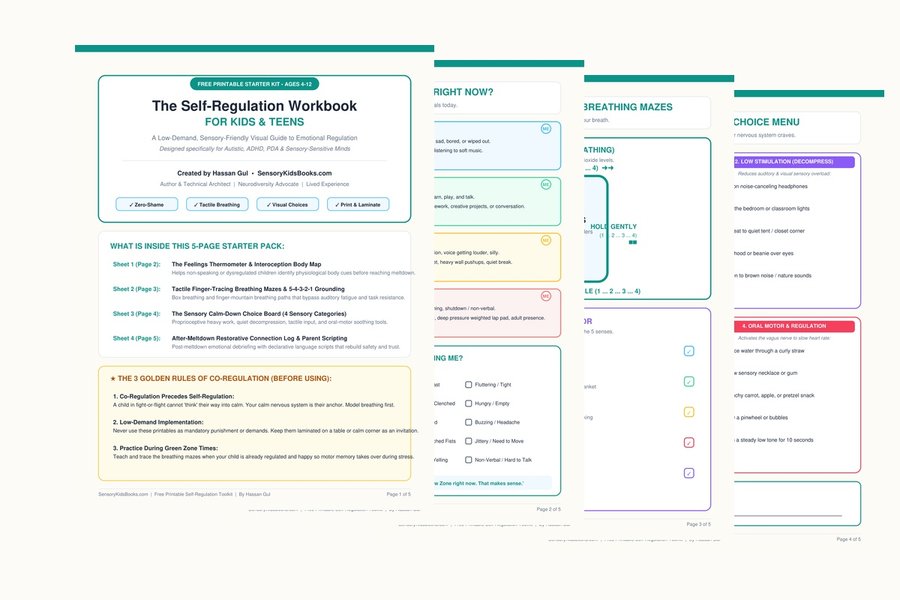
Instant 1-click PDF download: The Self-Regulation Workbook for Kids is an evidence-based, 5-page visual printable toolkit for autism, ADHD, and sensory differences. Includes tactile breathing mazes, interoception feelings thermometers, and zero-shame calm-down menus.
If you are searching for the self-regulation workbook for kids PDF free download, you have landed in the right place. There are zero paywalls, zero broken placeholder links, and zero forced credit card gates on this page. Below, you can immediately download our complete 5-page, high-resolution printable PDF starter kit created specifically for autistic children, kids with ADHD, sensory processing sensitivity, and Pathological Demand Avoidance (PDA).
👉 Click here to download the high-res printable PDF right now: Download The Free Self-Regulation Workbook Starter Kit (Instant PDF))
This printable starter kit is pre-formatted for standard 8.5" x 11" Letter paper. You can print it immediately on your home printer or classroom workstation, slip it into plastic sheet protectors or laminate it with 3-mil pouches, and place it in your child's calm-down corner or sensory haven.

As an autistic adult, parent, and technical architect, I have watched traditional behavioral psychology fail neurodivergent children for decades. For years, educators and therapists have handed children cognitive-heavy worksheets asking them to 'identify negative self-talk' or 'make good choices' in the middle of a screaming, sensory-induced meltdown.
Here is the biological truth that traditional behaviorism ignores: you cannot reason with a child whose amygdala has hijacked their prefrontal cortex.
When a child is in the throes of autistic sensory overload, ADHD task paralysis, or a PDA demand panic, their sympathetic nervous system is flooded with adrenaline and cortisol. Blood flow literally retreats from the rational executive functioning centers of the brain into the primitive limbic system. Demanding that a child 'use their words,' 'fill out a worksheet,' or 'calm down' during this state doesn't de-escalate them—it triggers an intensified fight, flight, or freeze defense mechanism.
Self-regulation is not an innate skill that children deliberately withhold to defy authority. It is a physiological capacity built on three sequential pillars: Interoception (body awareness), Sensory Regulation (nervous system stabilization), and Co-Regulation (anchoring to a calm, safe adult).
We built this 5-page printable toolkit using low-demand visual architecture. It eliminates linguistic clutter, relies on tangible tactile feedback, and gives the child autonomy without feeling judged.
Most children cannot tell you 'I feel anxious' because they have poor interoception—the internal sensory sense that detects hunger, thirst, heart rate, and emotional tension. They only realize something is wrong when their nervous system detonates.
Sheet 1 breaks energy states down into 4 clear, neurodiversity-affirming zones:

When a child is overwhelmed, telling them to 'take a deep breath' is an auditory demand that often triggers PDA or task paralysis. They literally cannot process verbal commands.
Instead of verbal prompts, Sheet 2 uses tactile motor paths. Have your child place their index finger directly on the paper and trace the rounded Box Breathing square:
Tracing the physical surface engages proprioceptive receptors in the fingertips, which grounds the somatic nervous system and activates the parasympathetic 'rest-and-digest' branch of the vagus nerve.

Neurodivergent children need autonomy. When adults enforce a specific coping mechanism (e.g. 'sit in this chair right now'), it creates a power struggle. Sheet 3 offers structured visual choices across four evidence-based sensory channels:

What happens after a meltdown is just as important as how you handle the explosion. Too many systems force children to write 'apology letters' while they are still in emotional recovery, which induces intense toxic shame.
Sheet 4 is built on restorative repair. Once both adult and child are back in the Green Zone, you review the sheet together without blame:
It also arms parents with Declarative Language scripts—replacing commands like 'Calm down right now!' with grounding anchors like 'I am right here with you. You are safe. We can sit quietly together.'

While printable visual aids provide cognitive and visual scaffolding, sensory dysregulation requires physical sensory inputs. Over the years, these four tools have proven indispensable in our home and sensory room:
For children with high oral-motor sensory seeking needs, chewing clothing collars or pencils is a subconscious regulation strategy. A discreet, durable silicone chew pendant satisfies this proprioceptive input without ruining shirts.
shopping_cartCheck Price on Amazon: Sensory Chew Necklaces for Kidsopen_in_new
Weighted lap pads provide targeted Deep Touch Pressure (DTP) across the thighs, stimulating serotonin and melatonin production. It is much easier to transition and use during homework or reading than a full weighted blanket.
shopping_cartCheck Price on Amazon: Weighted Lap Pad for Kids (5 lbs)open_in_new
Time blindness is one of the biggest causes of transition meltdowns for ADHD and autistic children. A mechanical visual timer with an eroding colored disc turns abstract time into a concrete, non-verbal boundary.
shopping_cartCheck Price on Amazon: 60-Minute Visual Countdown Timeropen_in_new
A mesmerizing visual focal point that slows rapid eye movements and heart rate during sensory overload. Having one in your calm-down corner gives kids an effortless visual anchor to watch while catching their breath.
shopping_cartCheck Price on Amazon: Liquid Motion Bubbler Sensory Timeropen_in_new
This 5-page free starter kit will give your child immediate relief, but emotional regulation is a lifelong journey of self-discovery. If you need a comprehensive, year-round framework, explore our flagship publication:
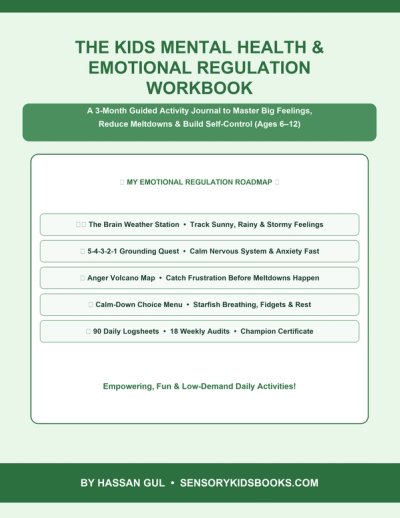
👉 The Kids Mental Health & Emotional Regulation Workbook by Hassan Gul.
The full 50+ page workbook includes daily emotional check-in logs, 25 visual emotion scales, interoception body maps, anger thermometers, social problem-solving scenarios, and complete IEP accommodation cheat sheets for schools.
Save this page to your bookmarks! You can re-download your free starter kit anytime using the direct links below:
📥 Download The Self-Regulation Workbook Starter Kit (Instant PDF)
 Instant PDF
A 3-Month (90-Day) Activity Journal to Master Big Feelings, Reduce Meltdowns, and Build Self-Regulation (Ages 6–12)
Carefully curated products for a sensory-friendly environment.
Oral Motor Calm
Durable medical-grade silicone chew jewelry that prevents shirt chewing and calms sensory anxiety.
Deep Touch Pressure
Provides soothing proprioceptive sensory input across the legs to settle restless bodies during focus time.
Get our monthly guide on sensory-aware parenting and neuro-inclusive home design delivered straight to your sanctuary.
Respecting your inbox and your peace of mind.
No comments yet. Be the first to share your thoughts!
Your email address will not be published. Required fields are marked *
Executive Function
Eroding colored disc that eliminates transition anxiety and power struggles without loud beeping.
Visual Grounding
Calming visual timer that helps slow breathing and heart rate during emotional floods.