Is It a Phase or Autism? Understanding Autistic Traits in 4-Year-Olds

Understanding autistic traits in 4-year-olds involves recognizing sensory sensitivities, parallel play preferences, intense special interests, emotional regulation needs, and communication styles.
Editorial Disclosure & Medical Scope: Sensory Kids Books shares neurodiversity-affirming, lived-experience insights and sensory-informed tools for parents, caregivers, and educators. This publication is for educational purposes only and does not constitute formal medical diagnosis, psychiatric evaluation, or clinical occupational therapy advice. Always consult a qualified pediatrician or licensed clinician for individual medical care. As an Amazon Associate, we earn from qualifying purchases through our independent affiliate links at zero extra cost to you.
As a parent, the preschool years are a whirlwind. One minute your 4-year-old is peacefully lining up their toy cars, and the next they are experiencing a massive meltdown because the red cup is in the dishwasher. You might catch yourself Googling at 2 AM, "Is this just a toddler phase, or is this autism?"
You are not alone. When my own child was four, I found myself reading clinical checklists that felt cold and detached. They listed "deficits" and "symptoms" without explaining what they actually looked like in the living room.
In this guide, we are going to break down the most common autistic traits in 4-year-olds. We'll move past the clinical jargon and look at what neurodivergence actually looks like in real life—from echolalia to sensory sensitivities—and what you can do to support your child's unique brain.
The 4-Year-Old Baseline (What to Actually Expect)
Before we dive into autistic traits, it helps to understand the baseline. Typical 4-year-olds are fiercely independent. They are beginning to play withother children rather than just nextto them. They can follow two-step directions, tell simple stories, and are starting to grasp the concept of time (like "after lunch").
However, neurodivergent children often follow a completely different developmental timeline. And that is okay. Autism is not a linear delay; it is a spiky profile. Your child might be able to read complex words at age four (Hyperlexia) but struggle to ask for a glass of water.
Social & Communication Differences
One of the primary areas where autistic traits in 4-year-olds emerge is in how they communicate and interact with the world around them.
Echolalia (Scripting vs. Conversing)
Does your child repeat lines from Blueyor Paw Patrolwith perfect intonation, even when it seems out of context? This is called Gestalt Language Processing(or Echolalia). Instead of building language word-by-word, they learn language in chunks or "scripts." If your 4-year-old says, "To infinity and beyond!"every time they want to go outside, they aren't just reciting a movie—they are communicating with you!
Parallel Play vs. Interactive Play
While neurotypical 4-year-olds begin to engage in cooperative play (like building a tower together), an autistic 4-year-old may strongly prefer parallel play. This means they will happily sit next to another child in the sandbox, completely engrossed in their own world, without actively interacting. They aren't being "anti-social"; their brain is simply prioritizing the sensory experience of the sand over the social demands of the peer.
Eye Contact and Non-Verbal Cues
For many autistic individuals, maintaining eye contact is physically uncomfortable—sometimes even painful. If your 4-year-old looks at your mouth, your shoulder, or away entirely when speaking to you, it does not mean they aren't listening. In fact, looking away often helps them concentrate on what you are saying because it reduces visual sensory input.
Repetitive Behaviors & Special Interests (Stimming)
Repetitive behaviors (often called stimming) are the nervous system's way of self-regulating.
The Beauty of Deep Focus (Trains, Dinosaurs, Letters)
A neurotypical 4-year-old might bounce from toys to crayons to the TV in a span of 10 minutes. An autistic 4-year-old might spend two straight hours spinning the wheels of a single toy truck. These intense special interests are a core autistic trait. Whether it's memorizing train schedules, categorizing dinosaurs, or obsessing over the alphabet, this deep focus is a profound strength.
Hand-Flapping, Spinning, and Lining Up Toys
If your child flaps their hands when they are excited, spins in circles until they are dizzy, or insists on lining up their action figures in perfect size order—they are stimming. They are seeking predictable sensory input to calm their nervous system. Never try to stop a harmless stim.It is their biological coping mechanism.
Sensory Sensitivities & Meltdowns
Sensory processing differences are incredibly common in autism. A 4-year-old's brain is processing millions of inputs, and for an autistic child, the "filter" is often broken.
Why Clothing Tags and Loud Noises Hurt
Does your child scream when you try to put them in jeans? Do they cover their ears when the vacuum turns on? To a neurodivergent brain, a scratchy clothing tag can feel like sandpaper, and a loud noise can trigger a physical pain response in the amygdala. Providing accommodations like noise-canceling headphonesor seamless socks can instantly reduce their daily stress load.
The Difference Between a Tantrum and a Meltdown
This is the most critical distinction for parents to make:
- A Tantrumis behavioral. It happens because a child wants something (e.g., a cookie) and stops when they get it or realize they won't.
- A Meltdownis neurological. It is a complete loss of control due to sensory or emotional overload. It will not stop just because you give them the cookie. They need a low-demand, quiet environment to ride it out.
*(If your child struggles with transitions and meltdowns, our free PDA Declarative Language Translatorcan help you phrase requests in a way that bypasses their threat response.)*
The PDA (Pathological Demand Avoidance) Factor
Sometimes, what looks like stubbornness is actually an anxiety-driven need for autonomy. Pathological Demand Avoidance (PDA) is a profile of autism characterized by an extreme avoidance of everyday demands. If your 4-year-old refuses to put on their shoes, eat dinner, or leave the house—not because they don't want to, but because the demand itselftriggers a panic response—you might be seeing traits of PDA.
Next Steps for Parents
If you are reading this and thinking, "Wow, this sounds exactly like my child,"take a deep breath. Autism is not a tragedy; it is simply a different operating system.
How to Request a Preschool Evaluation
If your child is 4 years old and attending a public preschool program (or if you are in the US), you can request a free educational evaluation through your local school district. Write a formal letter stating your concerns and requesting an assessment for an IEP (Individualized Education Program).
*(Need help writing your IEP goals? Use our free IEP SMART Goal Generatorto draft measurable goals for your meeting.)*
What to Do While You Wait
Medical waitlists for a formal autism diagnosis can be 12 to 18 months long. You do not need a piece of paper to start supporting your child today.
- Reduce Demands:Use declarative language ("I notice your shoes are by the door") instead of imperatives ("Put your shoes on").
- Honor Their Sensory Needs:Create a calm-down corner in your house.
- Use Visuals:4-year-olds thrive on predictability. Implement a daily visual schedule to reduce transition anxiety.
Understanding your child's autistic traits is the first step toward building a home environment where they don't just survive, but truly thrive.
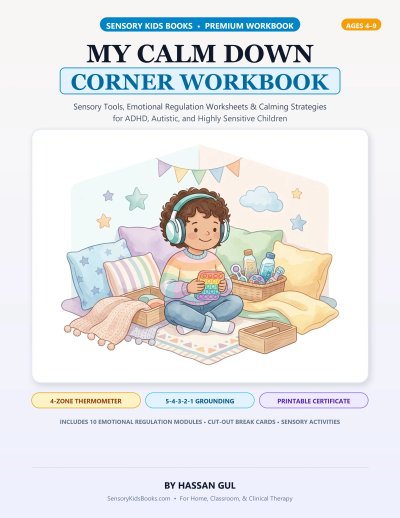 Instant PDF
My Calm Down Corner Workbook
Sensory Tools, Emotional Regulation Worksheets & Calming Strategies for ADHD, Autistic, & Sensitive Kids (Ages 4–9)
Quick Answers for Parents & Educators
Recommended Sensory Products
Carefully curated products for a sensory-friendly environment.

Weighted Lap Pad
BEST FOR FOCUS
Providing 5lbs of gentle pressure to help children stay grounded during long reading sessions.

Dimmable Warm LED
SENSORY FRIENDLY
Flicker-free technology with adjustable color temperatures to prevent eye strain.
📚 Evidence-Based Sources & Citations
Peer-reviewed literature, clinical frameworks, and foundational neurodiversity resources referenced in this guide.
- Occupational Therapy Practice Framework: Domain and Process (4th Edition) — American Occupational Therapy Association (AOTA)(2020)View Sourceopen_in_new
- The Polyvagal Theory: Neurophysiological Foundations of Emotions, Attachment, Communication, and Self-Regulation — Dr. Stephen W. Porges, PhD(2011)View Sourceopen_in_new
- Understanding Pathological Demand Avoidance (PDA): Identifying Needs & Low-Demand Approaches — PDA Society UK(2023)View Sourceopen_in_new
- Sensory Processing Issues Explained: Supporting Children with Sensory Sensitivities — Child Mind Institute(2024)View Sourceopen_in_new
Join the Conversation
Get our monthly guide on sensory-aware parenting and neuro-inclusive home design delivered straight to your sanctuary.
Respecting your inbox and your peace of mind.
Leave a Reply
Your email address will not be published. Required fields are marked *