ADHD Dopamine Menu Template for Teens (Free PDF): How to Beat Task Paralysis & Doom-Scrolling
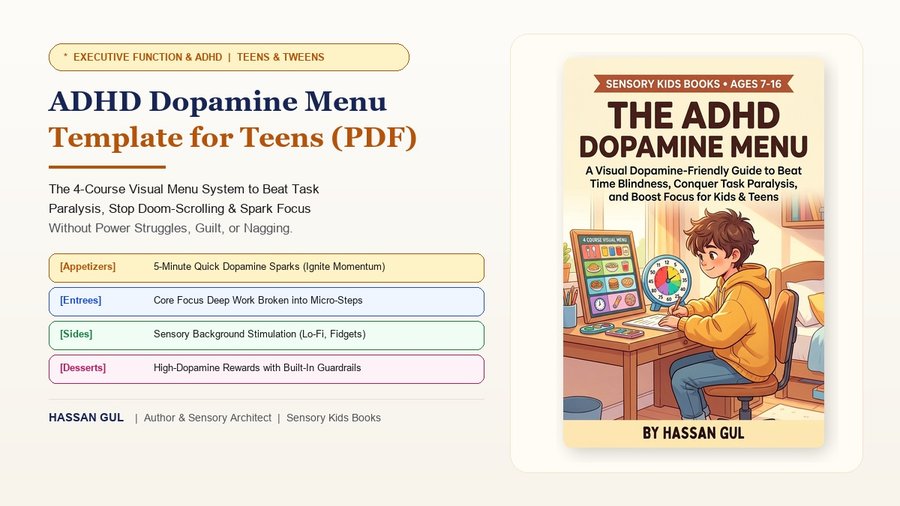
Struggling with homework paralysis, endless phone scrolling, and after-school overwhelm? Download our free 8-page ADHD Dopamine Menu Template for Teens and discover the 4-course visual system that sparks dopamine, breaks study freeze, and restores calm focus without guilt.
Editorial Disclosure & Medical Scope: Sensory Kids Books shares neurodiversity-affirming, lived-experience insights and sensory-informed tools for parents, caregivers, and educators. This publication is for educational purposes only and does not constitute formal medical diagnosis, psychiatric evaluation, or clinical occupational therapy advice. Always consult a qualified pediatrician or licensed clinician for individual medical care. As an Amazon Associate, we earn from qualifying purchases through our independent affiliate links at zero extra cost to you.
It is 7:30 PM on a Tuesday. Your teenager is sitting at their desk with their chemistry textbook open to page 142. They have been staring at the exact same paragraph for forty-five minutes. Their phone is buzzing face-down on the bed. Their shoulders are hunched, their jaw is clenched, and when you gently knock on the door and ask, "How’s the homework going?", they snap with sudden, explosive rage.
From the outside, it looks like stubborn defiance, procrastination, or phone addiction. But inside the neurodivergent brain, this is ADHD Task Paralysis (the "freeze" state). As an architect father raising neurodivergent kids, I have watched this exact tragedy unfold hundreds of times. The student desperately wants to do the work. They are terrified of failing. But their prefrontal cortex has hit a literal neurochemical roadblock: a complete drought of dopamine and norepinephrine.
Traditional study planners fail teens with ADHD because they are designed for neurotypical brains that operate on long-term consequences ("If I study tonight, I will get an A next month"). The ADHD brain does not run on consequences—it runs on the Interest-Based Nervous System. To ignite motivation, you don’t need more discipline. You need a Dopamine Menu.
Download Your Free ADHD Dopamine Menu Template (8-Page PDF)
Before we explore the neuroscience and fill in each course, grab your complete 8-page printable starter kit—ready to print in high-resolution vector PDF:
👉 Click Here to Download The ADHD Dopamine Menu Template for Teens (Free 8-Page PDF)
Includes: Module 01 Dopamine Engine Tracker, 5-Minute Appetizers Spread, Deep-Focus Entree Micro-Step Matrix, Sensory Side Dish Blueprint, and the Official Master Certificate of Executive Function Mastery.
The Dopamine Engine: Why ADHD Brains Starve for Stimulation
Dopamine is the neurotransmitter responsible for attention, motivation, executive initiation, and working memory. In neurotypical individuals, dopamine is released steadily in response to internal goals and routines. But as pioneering ADHD researcher Dr. Russell Barkley has demonstrated, individuals with ADHD have fewer dopamine transporters and receptors in the prefrontal cortex.
This produces a condition known as Reward Deficiency Syndrome. When an ADHD teenager is faced with a repetitive, non-novel task (like memorizing vocabulary or completing algebra worksheets), their dopamine levels drop below the threshold required to initiate motor action. Their body feels physically pinned to the chair.
This is why teens gravitate toward smartphones. TikTok and Instagram Reels do not require executive initiation; they deliver passive, instant bursts of novelty every 7 seconds. The phone is not the enemy—it is simply the fastest available dopamine tap in the room. A Dopamine Menu solves this by offering healthy, pre-planned stimulation alternatives that ignite the brain without sucking your teen into a 4-hour doom-scroll.
The 4-Course Architecture: How to Structure an ADHD Dopamine Menu
Just like a gourmet restaurant menu, an ADHD Dopamine Menu divides activities into four distinct courses based on preparation time, effort, and neurological payoff:
1. Appetizers (Quick 5-Minute Dopamine Sparks)
• Purpose: To wake up the brainstem and break task paralysis in under five minutes. Appetizers require virtually zero executive function and must never involve screens.
• Top Teen Appetizers:
– Cold water splash on face (triggers the calming mammalian dive reflex)
– Blasting 1 favorite high-energy pump-up song while jumping on a rebounder or stretching
– Stepping outside onto the porch for 3 minutes of brisk outdoor air and natural sunlight
– 10 wall push-ups or heavy proprioceptive joint compressions
– Chewing an intensely sour warhead candy or cinnamon mint
– Petting the family dog or cat for 2 minutes
– Making a hot mug of peppermint tea or iced chocolate milk
2. Entrees (Core Focus Projects Broken into Micro-Steps)
• Purpose: The heavy lifting. These are the academic assignments, study blocks, and life skills that require sustained cognitive effort.
• The Golden Rule of ADHD Entrees: Never list an entire assignment as an entree. Writing "Write History Paper" guarantees paralysis. Instead, shrink the entree into a 2-Minute Starter Micro-Step:
❌ "Clean entire bedroom" ➔ ✅ "Pick up 5 dirty shirts off the rug and put in hamper"
❌ "Study for Biology midterm" ➔ ✅ "Review flashcards for Chapter 3 using a 15-minute shopping_cartTime Timer visual countdown clockopen_in_new"
❌ "Write 5-page English essay" ➔ ✅ "Open a blank Google Doc, write the title, and write the very first sentence"
3. Sides (Sensory Scaffolding to Accompany Entrees)
• Purpose: Side dishes are paired during entree work to provide continuous background sensory stimulation. Without sensory sides, the ADHD brain will seek distraction.
• Top Sensory Sides for Teen Study Desks:
– Video game instrumental soundtracks (e.g., The Legend of Zelda, Skyrim, Minecraft) engineered to stimulate focus without distracting lyrics
– Bilateral brown noise or 40Hz gamma binaural beats via noise-canceling headphones
– Continuous tactile finger movement with a shopping_cartsilent magnetic desk penopen_in_new
– An active wobble stool or an shopping_cartunder-desk compact walking padopen_in_new to supply motor stimulation while reviewing notes
– Sucking cold fruit smoothies through a thick silicone straw
4. Desserts (High-Stimulation Rewards with Pre-Set Guardrails)
• Purpose: The super-satisfying, high-dopamine activities that make life fun. Video games, YouTube, social media, and hanging out with friends.
• The Guardrail Protocol: Desserts are never villainized in our framework. Shaming a teenager for enjoying video games only generates resentment and secrecy. Instead, desserts must have automatic, pre-committed physical stopping boundaries. Never rely on internal willpower to turn off a screen. Use physical visual timers, set an alarm in another room, or agree on a specific number of matches (e.g., "2 rounds of Rocket League") before sitting down.
Ergonomic Study Habitat: Tools to Scaffold the Teen ADHD Brain
Executive functioning is heavily influenced by physical spatial cues. When building your teen’s study habitat, pair their dopamine menu with these proven sensory tools:
A high-contrast disappearing red disc that makes abstract minutes physically visible. Keeps teens focused during 15-minute homework sprints without phone notifications.
shopping_cart👉 Check Current Price on Amazon (paid link)open_in_new
Sits right between keyboard and laptop. Keeps your teen’s chosen 5-minute appetizer and current micro-step in constant plain sight, eliminating forgotten tabs.
shopping_cart👉 Check Current Price on Amazon (paid link)open_in_new
Modular magnetic segments allow quiet tactile finger manipulation during reading and note-taking, channeling motor restlessness into focused energy.
shopping_cart👉 Check Current Price on Amazon (paid link)open_in_new
Allows kinesthetic ADHD teens to walk at 1.5 mph while memorizing vocabulary or listening to lectures, flooding the prefrontal cortex with focus neurotransmitters.
shopping_cart👉 Check Current Price on Amazon (paid link)open_in_new
How to Introduce a Dopamine Menu to a Skeptical Teen (Word-for-Word Script)
If you hand a teenager a blank template and announce: "We’re fixing your homework habits today!", their neuroceptive defenses will spike and they will resist. Use this collaborative, shame-free script instead:
"Hey, I learned something fascinating about how ADHD brains work. It turns out when you stare at chemistry and can’t start, your brain isn’t being lazy—it’s literally starving for dopamine. When dopamine is at zero, your brain physically locks up.
Instead of fighting your brain with rigid planners that don’t work, occupational therapists created something called a Dopamine Menu. It treats stimulation like food so you can choose healthy quick snacks to jumpstart your focus before tackling homework.
You pick all the items on the menu. I don’t pick any of them. Let’s grab some snacks and fill out your 5-minute appetizers together."
Looking for the Complete Executive Function Curriculum?
While our free 8-page PDF starter kit gets you up and running immediately, explore the full 30-page illustrated curriculum in our official bookshop:
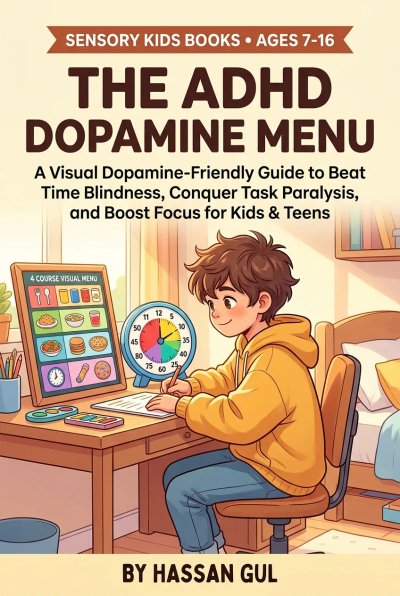
A visual, dopamine-friendly guide by Hassan Gul featuring 30 full-color interactive pages: Time Blindness Reality Checkers, Project Micro-Step Ladders, Sensory Pairing Blueprints, After-School Crash Protocols, and Cut-Out Desk Menu Boards.
👉 View The ADHD Dopamine Menu Toolkit in Our Shop ($8.99 Instant PDF / $16.99 Paperback)
Companion ADHD & Executive Function Guides
Deepen your teen’s self-regulation toolkit with our companion clinical guides and free interactive tools:
⏱️ How to Use Visual Timers to Beat ADHD Task Paralysis & Time Blindness
📘 52 Modern Manners for Teens PDF: Free Habit Checklist & Social Scripts
🫀 Vagus Nerve Exercises for Kids: 7 Somatic Reset Tools to Calm Meltdowns
🎓 Free 504 Plan & IEP Goal Generator Tool for Sensory & ADHD Accommodations
 Instant PDF
The ADHD Dopamine Menu & Executive Function Toolkit
A Visual Dopamine-Friendly Guide to Beat Time Blindness, Conquer Task Paralysis, and Boost Focus for Kids & Teens (Ages 7–16)
Quick Answers for Parents & Educators
Recommended Sensory Products
Carefully curated products for a sensory-friendly environment.
Time Timer 60-Minute Visual Countdown Clock
BEST VISUAL TIME BOUNDARY FOR ADULT & TEEN TASK SPRINTING
~$24–$32 | A physical eroding red disc that translates abstract minutes into a visible boundary. Bypasses phone timer distractions and helps teens initiate 15-minute homework sprints.
Glass Desktop Whiteboard Pad with Storage Drawer
BEST WORKING MEMORY SCAFFOLDING FOR TEEN DESKS
~$29–$39 | Positioned right below the monitor or laptop screen, this non-absorbent dry-erase surface keeps the current 5-minute dopamine appetizer and entree in direct visual line of sight.
Modular Magnetic Fidget Focus Desk Pen
BEST CLASSROOM-DISCREET PROPRIOCEPTIVE FIDGET TOOL
~$14–$19 | Discreet magnetic segments and bearings provide continuous tactile finger stimulation during lectures and study blocks without clicking noises or distracting classmates.
Under Desk Walking Pad Compact Treadmill
BEST MOTOR-STIMULATION & DEEP DOPAMINE ENHANCER
~$149–$199 | Allows ADHD teens and young adults to walk at 1.5 mph while reviewing flashcards, reading biology chapters, or listening to lectures, flooding the prefrontal cortex with focus neurotransmitters.
📚 Evidence-Based Sources & Citations
Peer-reviewed literature, clinical frameworks, and foundational neurodiversity resources referenced in this guide.
- Executive Functioning and the Interest-Based Nervous System in Adolescents with ADHD — Dr. Russell A. Barkley, Guilford Press(2022)View Sourceopen_in_new
- Dopamine Dysregulation and Reward Deficiency Syndrome in Neurodivergent Youth — Journal of Attention Disorders & NIH(2023)View Sourceopen_in_new
- Sensory Scaffolding and Environmental Ergonomics for Adolescent ADHD Study Habitats — American Journal of Occupational Therapy (AJOT)(2024)View Sourceopen_in_new
- How to Build an ADHD-Friendly Habitat: Low-Demand Systems for Neurodivergent Families — Hassan Gul, Sensory Kids Books Publishing(2026)View Sourceopen_in_new
Join the Conversation
Get our monthly guide on sensory-aware parenting and neuro-inclusive home design delivered straight to your sanctuary.
Respecting your inbox and your peace of mind.
Leave a Reply
Your email address will not be published. Required fields are marked *