10 Budget-Friendly Sensory Room Ideas for Home (Build a Calm Space Under $50)
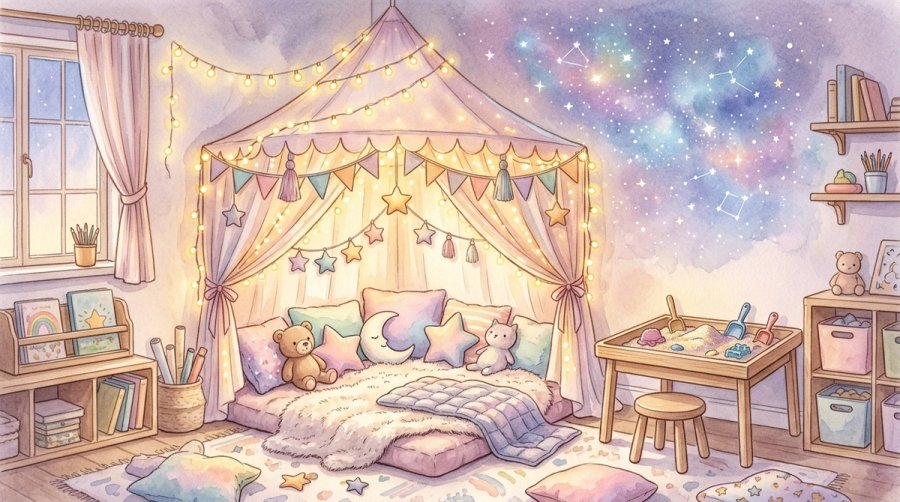
You do not need thousands of dollars to create a soothing sensory sanctuary. Discover 10 DIY, budget-friendly sensory room and calm-down corner ideas under $50 for autistic and ADHD kids.
Editorial Disclosure & Medical Scope: Sensory Kids Books shares neurodiversity-affirming, lived-experience insights and sensory-informed tools for parents, caregivers, and educators. This publication is for educational purposes only and does not constitute formal medical diagnosis, psychiatric evaluation, or clinical occupational therapy advice. Always consult a qualified pediatrician or licensed clinician for individual medical care. As an Amazon Associate, we earn from qualifying purchases through our independent affiliate links at zero extra cost to you.
If you have ever browsed Pinterest or Instagram for sensory room inspiration, you have probably seen breathtaking, multi-thousand-dollar clinic setups: commercial bubble tubes with remote controls, padded wall climbing structures, and custom fiberglass swings that look like they belong in a futuristic pediatric hospital.
As a parent navigating neurodivergence in a real family home with a real family budget, looking at those $5,000 setups can feel completely demoralizing. You know your child desperately needs a safe space to decompress after a loud school day or prevent an overwhelming sensory meltdown—but you do not have an empty master bedroom or thousands of dollars to spare.
Here is the liberating truth every occupational therapist wishes parents knew: the human nervous system does not care how much an item costs. A $15 pop-up tent with string lights and old duvet pillows provides the exact same neurological co-regulation and felt safety as a $1,200 commercial sensory pod.
In this guide, I am breaking down 10 practical, highly effective DIY sensory room and calm-down corner ideas that you can set up this weekend for under $50 each—even in a small shared bedroom or living room nook.
Sensory Seekers vs. Sensory Avoiders: Know Your Child's Profile
Before buying or building anything, the most critical step is identifying your child's primary sensory profile:
1. The Sensory Avoider (Needs a Low-Stimulation Sanctuary): These children are easily overloaded by bright lights, loud noises, and visual clutter. Their ideal sensory space requires dark, enclosed corners, sound dampening, soft muted textures, and minimal visual noise.
2. The Sensory Seeker (Needs Proprioceptive & Vestibular Input): These children crave heavy muscle pressure, swinging, jumping, chewing, and deep tactile exploration to ground their bodies. Their space needs safe crash pads, doorway swings, resistance bands, and textured sensory bins.
10 Budget-Friendly DIY Sensory Room Ideas
Here are 10 proven, cost-effective sensory sanctuary setups with direct links to find safe, durable gear:
1. The Pop-Up Sensory Den & Blanket Fortress ($15 - $25)
You do not need a dedicated room. A simple pop-up toddler play tent or a blanket draped over a sturdy corner chair creates an instant, enclosed sensory sanctuary. Line the interior with soft fleece blankets and throw pillows to block out distracting household movement.
👉 shopping_cartCheck Price on Amazon (kids indoor pop up tent sensory) →open_in_new
2. Calming Warm Fairy Lights & Star Projectors ($15 - $30)
Harsh overhead fluorescent and cold LED lighting flicker at frequencies that physically agitate neurodivergent nervous systems. Turn off the main ceiling light and install battery-operated warm amber fairy lights, an inexpensive galaxy star projector, or dimmable salt lamps to soothe visual strain.
👉 shopping_cartCheck Star Projectors on Amazon (galaxy star projector for bedroom) →open_in_new
3. The DIY Heavy Work Floor Crash Pad ($20 - $35)
Commercial crash pads cost $250+. You can make your own by taking a zippered twin duvet cover or king-size pillow protector and stuffing it with spare pillows, memory foam offcuts, and soft blankets. It provides a safe landing zone for sensory seekers needing heavy proprioceptive feedback.
👉 shopping_cartFind Heavy Crash Pads on Amazon (sensory crash pad kids) →open_in_new
4. The Tactile Exploration Wall Board ($10 - $20)
Mount a simple wooden frame or foam board to the wall at child height. Use hot glue to attach swatches of leftover fabric: reversible sequin material, bubble wrap, textured faux fur, corrugated cardboard, velcro strips, and silicone trivets. This gives busy hands an immediate regulating tactile outlet.
👉 shopping_cartCheck Sensory Activity Boards on Amazon (sensory activity board for wall) →open_in_new
5. Sound-Dampening Quiet Corner with Earmuffs ($15 - $25)
Place comfortable acoustic floor cushions in a quiet corner away from the TV and kitchen. Add a pair of child-sized noise-canceling earmuffs or a low-cost white noise sound machine playing gentle brown noise or falling rain.
👉 shopping_cartCheck Child Earmuffs on Amazon (kids noise canceling earmuffs autism) →open_in_new
6. Lycra Doorway Sensory Resistance Swing ($35 - $50)
If your child craves vestibular input (swinging, spinning, cocooning), install a secure doorway pull-up bar paired with a flexible double-layer Lycra swing fabric. The deep, 360-degree compression calms the central nervous system within 10 minutes of gentle swaying.
👉 shopping_cartCheck Lycra Swings on Amazon (kids indoor sensory swing autism) →open_in_new
7. The Deep Pressure & Weighted Station ($20 - $40)
Keep a 5-pound weighted lap pad, a sensory compression body sock, and a heavy knitted blanket rolled neatly in a basket inside the sensory nook. Children can pull them onto their lap while reading or resting to stimulate grounding serotonin release.
👉 shopping_cartCheck Weighted Lap Pads on Amazon (weighted lap pad for kids) →open_in_new
8. DIY Kinetic Sand & Rice Sensory Bins ($10 - $15)
Use a shallow plastic storage bin filled with dry rice, dried black beans, kinetic sand, or hydrated water beads. Hide small plastic animal figurines, measuring scoops, and silicone cups inside for minutes of quiet, immersive tactile regulation.
👉 shopping_cartCheck Kinetic Sand Bins on Amazon (kinetic sand sensory bin) →open_in_new
9. Calming Lavender Playdough & Scent Station ($5 - $10)
Scent is directly wired to the brain's emotional center (the limbic system). Make simple homemade playdough infused with 3 drops of pure lavender or chamomile essential oil. Squeezing and smelling the warm dough combines heavy hand work with aromatherapy.
👉 shopping_cartCheck Calming Scent Dough on Amazon (aromatherapy dough stress relief) →open_in_new
10. Visual Emotion Thermometer & Routine Checklist ($0 - $10)
Mount a visual emotion check-in board on the wall. When children are too dysregulated to speak (situational mutism during a shutdown), they can simply point to their emotional zone or follow a 3-step visual calm-down sequence without verbal pressure.
👉 shopping_cartCheck Visual Schedule Boards on Amazon (visual schedule board for kids) →open_in_new
How to Organize a Sensory Nook in a Small Space
The biggest mistake parents make is overcrowding the area with too many toys and gadgets. Visual clutter is sensory clutter. Keep only 3–4 core regulating items visible at any time, rotating secondary sensory toys into closed storage bins every two weeks to maintain interest without overload.
The Golden Rule: Give Your Child Full Control
A sensory room is not a punishment or a time-out chair. It must always be an autonomous sanctuary that your child chooses to enter. Let them control the light switch, pick their favorite textures, and leave whenever their nervous system feels restored.
Helpful Tools & Next Steps for Your Family
Equipping your sensory space with structured visual tools makes co-regulation effortless:
- 📘 My Calm Down Corner Workbook: Step-by-step printable visual check-ins, emotion thermometers, and 15+ proprioceptive reset cards you can laminate and hang in your sensory nook.
- 📅 Free Printable Daily Routine Schedule: Establish low-demand morning and bedtime visual routines that reduce anxiety and conquer executive dysfunction.
- 🔋 Free Autism Burnout Visual Recovery Guide: Track weekly sensory bandwidth, identify masking triggers, and protect your child's body battery before shutdowns occur.
- 🗣️ Free Declarative Language Translator: Convert demanding commands into supportive, low-demand observations that prevent autonomic threat spikes.
📚 Also check out our latest resource: Autism Burnout in Children & Teens.
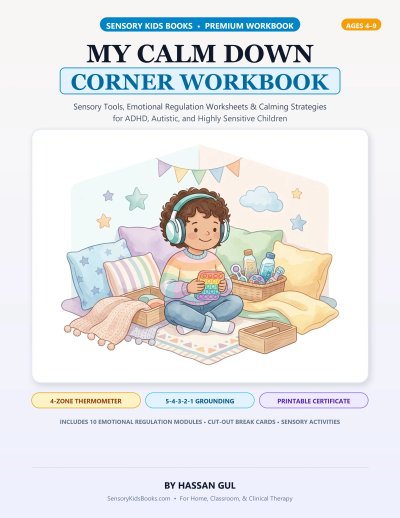 Instant PDF
My Calm Down Corner Workbook
Sensory Tools, Emotional Regulation Worksheets & Calming Strategies for ADHD, Autistic, & Sensitive Kids (Ages 4–9)
Quick Answers for Parents & Educators
Recommended Sensory Products
Carefully curated products for a sensory-friendly environment.

Weighted Lap Pad
BEST FOR FOCUS
Providing 5lbs of gentle pressure to help children stay grounded during long reading sessions.

Dimmable Warm LED
SENSORY FRIENDLY
Flicker-free technology with adjustable color temperatures to prevent eye strain.
📚 Evidence-Based Sources & Citations
Peer-reviewed literature, clinical frameworks, and foundational neurodiversity resources referenced in this guide.
- Occupational Therapy Practice Framework: Domain and Process (4th Edition) — American Occupational Therapy Association (AOTA)(2020)View Sourceopen_in_new
- The Polyvagal Theory: Neurophysiological Foundations of Emotions, Attachment, Communication, and Self-Regulation — Dr. Stephen W. Porges, PhD(2011)View Sourceopen_in_new
- Understanding Pathological Demand Avoidance (PDA): Identifying Needs & Low-Demand Approaches — PDA Society UK(2023)View Sourceopen_in_new
- Sensory Processing Issues Explained: Supporting Children with Sensory Sensitivities — Child Mind Institute(2024)View Sourceopen_in_new
Join the Conversation
Get our monthly guide on sensory-aware parenting and neuro-inclusive home design delivered straight to your sanctuary.
Respecting your inbox and your peace of mind.
Leave a Reply
Your email address will not be published. Required fields are marked *