Why Do Autistic Kids Script? Delayed Echolalia, Movie Quotes & Gestalt Language Guide
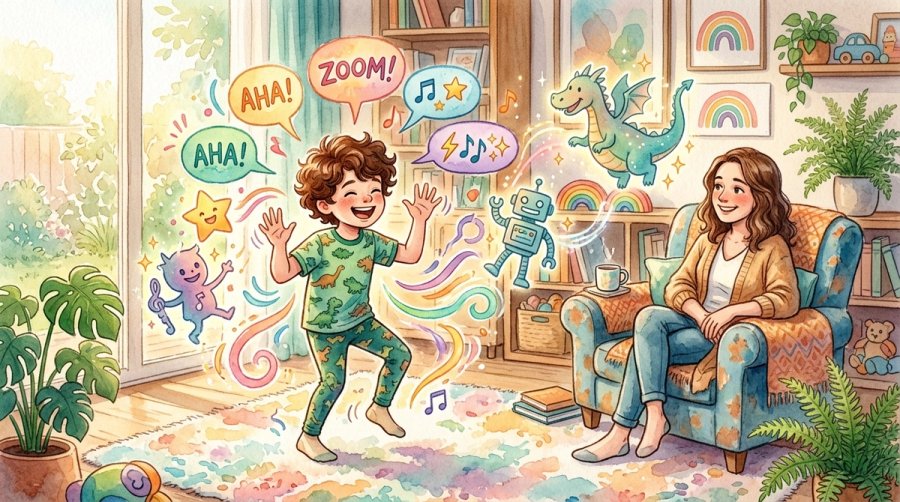
Autistic scripting (delayed echolalia) is not meaningless noise—it is Gestalt Language Processing (GLP). Learn the 6 stages of language acquisition and how to decode the hidden meaning behind your child movie quotes.
Editorial Disclosure & Medical Scope: Sensory Kids Books shares neurodiversity-affirming, lived-experience insights and sensory-informed tools for parents, caregivers, and educators. This publication is for educational purposes only and does not constitute formal medical diagnosis, psychiatric evaluation, or clinical occupational therapy advice. Always consult a qualified pediatrician or licensed clinician for individual medical care. As an Amazon Associate, we earn from qualifying purchases through our independent affiliate links at zero extra cost to you.
If you are raising an autistic child, you have likely experienced this scene: instead of answering your question with 'Yes' or 'No', your child smiles and recites an entire 30-second scene from Disney's Toy Story, a Bluey episode, or a YouTube elevator safety announcement verbatim—complete with exact voice intonation and sound effects.
For decades, traditional behavioral frameworks dismissed this behavior as 'meaningless delayed echolalia' or 'non-functional vocal stimming.' Parents were often told to ignore, interrupt, or extinguish these movie quotes in favor of standard single-word speech.
Modern neuro-affirming speech research has revealed the opposite truth: scripting is not meaningless noise. It is a sophisticated, deeply intentional form of communication known as Gestalt Language Processing (GLP).
As a father navigating neurodivergence in my home, learning to decode my children's scripts was like being handed a master translation key. Once you understand the emotional context behind each line, scripting transforms from a puzzling puzzle into one of the most intimate ways your child connects with the world.
In this comprehensive guide, we will unpack why autistic kids script, the 6 stages of Gestalt Language Acquisition, how to decode the hidden emotional meaning behind movie quotes, and how parents can support spontaneous, flexible language.
What Is Scripting & Delayed Echolalia?
Scripting is the repetition of memorized chunks of language—lines from television shows, books, songs, video games, or phrases spoken by parents or teachers. In speech pathology, this is formally termed delayed echolalia.
Immediate Echolalia: Repeating words or phrases immediately after hearing them (e.g., Parent says 'Do you want water?' and child repeats 'Want water?').
Delayed Echolalia (Scripting): Reciting words, sentences, or entire dialogues hours, days, weeks, or even years after hearing them in a specific emotional context.
The Science: Gestalt Language vs. Analytic Language Processing
To understand scripting, we must recognize that human brains develop language through two distinct pathways:
1. Analytic Language Processors (ALPs): Most neurotypical children are analytic processors. They learn language word-by-word (e.g., 'Ball' → 'Big ball' → 'I want the big ball'). They build sentences like LEGO bricks.
2. Gestalt Language Processors (GLPs): Almost all autistic children (and many hyperlexic/ADHD kids) are Gestalt language processors. They process language as whole 'chunks' or melodies (gestalts) tied to an overarching emotional experience before breaking them down into individual words.
When a GLP child hears Woody say 'To infinity and beyond!' during an exciting scene, their brain does not store four separate vocabulary words. It stores the entire audio chunk as a single unit of meaning representing pure joy, bravery, or readiness for adventure.
The 6 Stages of Natural Language Acquisition (NLA Framework)
Developed by speech-language pathologist Marge Blanc, the Natural Language Acquisition (NLA) framework outlines how Gestalt processors naturally progress from rigid scripts into flexible, original grammar:
Stage 1: Whole Gestalts (Delayed Echolalia)
The child speaks exclusively in whole memorized scripts. A child who says 'Be our guest, be our guest!' is not roleplaying Disney—they may be expressing 'I am hungry, let's eat dinner!'
Stage 2: Mitigations (Mix & Match)
The child begins slicing long gestalts into smaller pieces and combining them. For example, combining 'Let's go outside' + 'and eat ice cream' into 'Let's go ice cream!'
Stage 3: Isolated Single Words & Two-Word Pairs
The child breaks scripts down into individual building blocks and begins creating flexible, non-scripted 2-word combinations (e.g., 'Mommy blue', 'Big dog').
Stage 4–6: Original Grammar & Complex Sentences
The child develops self-generated, spontaneous grammar, past-tense verbs, and sophisticated conversational flexibility while retaining their creative, intonation-rich communication style.
The 4 Primary Reasons Autistic Kids Script
Scripting serves four distinct neurological functions in everyday life:
1. Functional Communication & Connection
Because expressive vocabulary takes massive executive energy, children use scripts as emotional shorthand to convey complex feelings, requests, or boundaries.
2. Emotional Regulation & Self-Soothing
Familiar scripts provide auditory predictability. In loud, overwhelming sensory environments (like grocery stores or crowded classrooms), repeating a comforting cartoon line lowers cortisol and calms the autonomic nervous system.
3. Vocal Stimming & Auditory Joy
Autistic children frequently experience intense sensory pleasure from the rhythm, acoustics, and mouth-feel of specific words and pitches (vocal stimming).
4. Cognitive Processing & Memory Play
Reciting scripts allows neurodivergent brains to index past experiences, rehearse upcoming social interactions, and make sense of novel situations.
How Parents Can Decode and Support Scripting (The Do's & Don'ts)
Transforming scripting into a bridge for communication requires shift in perspective:
✓ Tune into the Intonation and Emotion: Listen to the tone of voice. A panicked script means distress; a cheerful sing-song script means safety.
✓ Acknowledge and Repeat: Validate the script by repeating it back with warmth. This signals to your child: 'I hear you, and your words are safe with me.'
✓ Model Declarative Language: Replace demanding questions ('What do you want?') with open declarative observations ('I see you looking at the snack cupboard').
❌ DO NOT Interrupt or Extinguish: Forcing a child to stop scripting robs them of their primary emotional regulator and causes shutdowns.
Helpful Sensory & Communication Tools
Pairing language support with visual and sensory aids reduces communication anxiety:
1. Visual Picture Exchange & AAC Communication Boards
Provides a non-verbal alternative during sensory fatigue so kids don't have to rely solely on verbal output.
2. Feeling & Emotion Thermometer Visual Cards
Helps Gestalt processors connect their favorite character scripts to specific internal body sensations and emotional zones.
3. Chewable Oral Sensory Stims & Chewy Necklaces
Provides satisfying proprioceptive jaw feedback for children who love oral and vocal sensory stimulation.
👉 shopping_cartCheck Sensory Chews on Amazon (chewy necklace for sensory autistic kids) →open_in_new
Helpful Tools & Next Steps for Your Family
Equipping your home with low-demand communication frameworks nurtures effortless connection:
- 🗣️ Free Declarative Language / PDA Translator Tool: Convert high-pressure verbal demands into low-friction, neuro-affirming observations with one click.
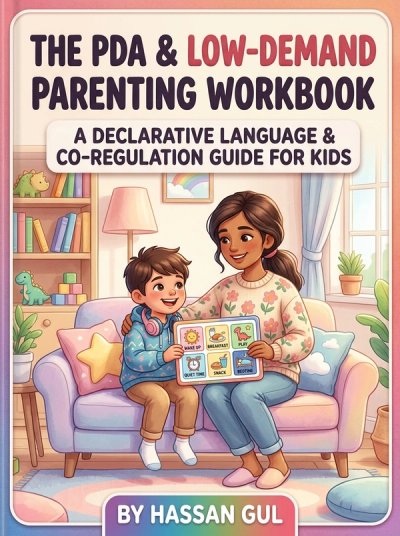
- 📘 The PDA & Low-Demand Parenting Workbook for Kids: Step-by-step low-demand scripts, co-regulation tools, and nervous system recovery worksheets.
- 📅 Free Printable Daily Routine Schedule: Establish predictable daily visual rhythms with built-in quiet sensory recovery blocks.
- 🔋 Free Autism Burnout Visual Recovery Guide: Monitor your child's weekly sensory battery and protect against executive exhaustion.
📚 Also check out our latest guide: Why Does My Child Cover Their Ears? A Guide to Auditory Sensory Overload.
📚 Also check out our latest guide for late-diagnosed neurodivergent individuals: Pathological Demand Avoidance (PDA) in Adults: Signs & Recovery.
 Instant PDF
The PDA Parenting Playbook
A Low-Demand, Sensory-Friendly Workbook for Navigating Pathological Demand Avoidance
Quick Answers for Parents & Educators
Recommended Sensory Products
Carefully curated products for a sensory-friendly environment.
Visual AAC Communication Board
COMMUNICATION AID
A great low-demand tool for when verbal output is too hard.
Sensory Chewy Necklace
SENSORY STIM
Provides deep pressure to the jaw for kids who vocal stim.
📚 Evidence-Based Sources & Citations
Peer-reviewed literature, clinical frameworks, and foundational neurodiversity resources referenced in this guide.
- Occupational Therapy Practice Framework: Domain and Process (4th Edition) — American Occupational Therapy Association (AOTA)(2020)View Sourceopen_in_new
- The Polyvagal Theory: Neurophysiological Foundations of Emotions, Attachment, Communication, and Self-Regulation — Dr. Stephen W. Porges, PhD(2011)View Sourceopen_in_new
- Understanding Pathological Demand Avoidance (PDA): Identifying Needs & Low-Demand Approaches — PDA Society UK(2023)View Sourceopen_in_new
- Sensory Processing Issues Explained: Supporting Children with Sensory Sensitivities — Child Mind Institute(2024)View Sourceopen_in_new
Join the Conversation
Get our monthly guide on sensory-aware parenting and neuro-inclusive home design delivered straight to your sanctuary.
Respecting your inbox and your peace of mind.
Leave a Reply
Your email address will not be published. Required fields are marked *