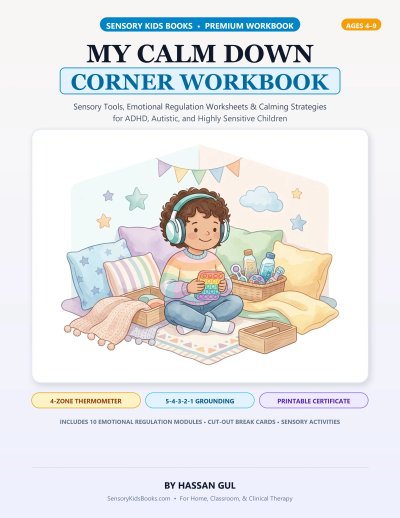
How to Create a Calm Sensory Corner at Home (On a Budget)

A calm sensory corner is a designated low-stimulation home sanctuary equipped with soft lighting, weighted pillows, tactile tools, and visual calm-down charts to help children self-regulate.
When my child was first diagnosed with Sensory Processing Disorder, I made the mistake of browsing expensive occupational therapy catalogs. I saw thousand-dollar sensory swings, massive bubble tubes, and specialty crash pads. I immediately felt overwhelmed—did I need to convert my entire living room into a high-end clinic?
The answer is a resounding no. You do not need to spend a fortune to support your child’s nervous system. Over the years, I’ve learned that the most effective regulation spaces are often the simplest. Here is how to create a calm sensory corner at home on a tight budget.
1. Define the Space (Keep It Small)
Sensory overload makes the world feel too big, too loud, and too bright. A calm corner should feel like a safe, enclosed den. You don’t need a dedicated room. A quiet corner of a bedroom, a cleared-out closet, or the space under a loft bed works perfectly.
If you have an open space, use a cheap pop-up play tent or simply drape a dark, heavy blanket over two chairs. The goal is to reduce visual clutter and create a physical boundary between the "busy" house and the "safe" space.
2. The "Touch" Element: Repurpose What You Have
Proprioceptive and tactile input are incredibly grounding for a dysregulated nervous system. Instead of buying an expensive crash pad, I repurposed an old foam mattress topper, folded it in half, and covered it with a soft duvet cover.
You can also use old couch cushions, a rolled-up yoga mat, or oversized pillows. If you can’t afford a weighted blanket, layering three or four regular, heavy winter blankets provides a remarkably similar deep-pressure sensation.
3. Master the Lighting and Sound
Harsh overhead lighting is a major trigger. Keep the sensory corner dimly lit. A cheap set of warm-white string lights (fairy lights) draped inside the tent provides just enough illumination without being abrasive.
For sound, you don’t need a fancy sound machine. An old oscillating fan provides excellent white noise to drown out household chatter. I also highly recommend keeping a pair of basic noise-canceling earmuffs inside the corner at all times.