PDA vs. ODD: Why Traditional Discipline Backfires on Demand Avoidant Kids
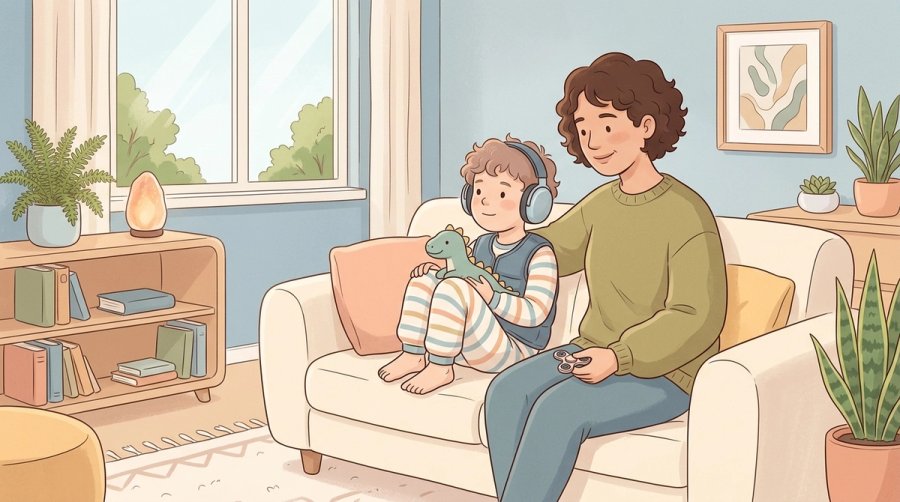
Told your child has ODD? If traditional discipline makes meltdowns worse, your child may have PDA. Here is the neuroscience of demand panic and the low-demand blueprint that works.
Editorial Disclosure & Medical Scope: Sensory Kids Books shares neurodiversity-affirming, lived-experience insights and sensory-informed tools for parents, caregivers, and educators. This publication is for educational purposes only and does not constitute formal medical diagnosis, psychiatric evaluation, or clinical occupational therapy advice. Always consult a qualified pediatrician or licensed clinician for individual medical care. As an Amazon Associate, we earn from qualifying purchases through our independent affiliate links at zero extra cost to you.
If you are raising or teaching a child who explodes into an uncontrollable panic over basic daily requests—like putting on shoes, brushing teeth, or eating lunch—you have almost certainly been told by a pediatrician, school counselor, or family member: 'Your child has Oppositional Defiant Disorder (ODD). You just need to be more consistent with punishments.'
So you try what the parenting books recommend: sticker charts, token economies, loss of screen time, and firm authoritative boundaries. And what happens? The meltdowns don't stop. They become ten times more violent. Your child throws items, screams, runs away, or shuts down completely into non-verbal paralysis.
Here is the medical truth that is failing thousands of children: Pathological Demand Avoidance (PDA)—also recognized in the neurodivergent community as a Pervasive Drive for Autonomy—is NOT Oppositional Defiant Disorder.
Misdiagnosing a PDA child with ODD and applying traditional behavioral discipline is one of the most psychologically damaging mistakes an educational or therapeutic team can make. In this comprehensive clinical comparison, I will break down the neurobiological distinction between ODD and PDA, explain why reward/punishment systems trigger acute fight-or-flight panic, and provide the low-demand parenting framework that restores peace to your home.
💡 Helpful Resource: If you need to assess your child's nervous system patterns, see our complete 25-Point PDA Checklist for Children & Printable Low-Demand Guide for clinical indicators and declarative language scripts.
The Core Neurological Difference: Defiance vs. Panic
To understand why traditional discipline backfires, we must examine the underlying driver of the behavior:
Oppositional Defiant Disorder (ODD): A Behavioral Conflict with Authority
- 🎯 The Driver: ODD is classified in the DSM-5 as a disruptive behavior disorder characterized by an angry/irritable mood, argumentative behavior, and vindictiveness.
- ⚖️ Social Dynamics: The defiance is typically directed at authority figures (parents, teachers, bosses) rather than peers.
- 🧠 The Brain State: The child feels in control of their choices. They are actively choosing to push back against a rule they dislike.
Pathological Demand Avoidance (PDA): An Autonomic Threat Response
- 🚨 The Driver: First identified by British child psychologist Dr. Elizabeth Newson at the University of Nottingham, PDA is a neurodivergent profile on the autism spectrum driven by an intense, neurological panic response to perceived loss of autonomy.
- ⚡ The Brain State: A demand is not perceived as an inconvenience; it is perceived by the amygdala as an existential, life-threatening danger. The child's nervous system instantly drops into sympathetic fight, flight, freeze, or fawn.
- 🪞 Internal Demands: Unlike ODD, PDA children will even avoid things they desperately WANT to do. If a child loves swimming, the moment someone says 'Time for your swim lesson!' or the child feels an internal expectation to swim, their nervous system locks up in demand paralysis.
Why Traditional Discipline Disasters Happen with PDA Kids
Every standard parenting program (1-2-3 Magic, Love and Logic, behavioral reward charts) relies on behavioral conditioning: rewarding compliance and punishing non-compliance. When applied to a PDA child, this approach is disastrous:
- ❌ Reward Charts Increase Pressure: 'If you brush your teeth, you get a star!' sounds harmless, but to a PDA brain, that star is a conditional demand with performance expectations attached. It spikes anxiety, leading to intentional sabotage.
- ❌ Punishments Confirm Threat: Taking away an iPad or placing the child in time-out validates the amygdala's belief: 'Adults are dangerous authorities trying to strip away my autonomy.' The child fights harder for survival.
- ❌ Escalating Consequences Cause Trauma: When parents increase consequences, PDA children do not back down—they escalate to physical violence or plunge into Dorsal Vagal catatonic shutdown.
The PANDA Low-Demand Framework: How to Actually Help a PDA Child
The UK's PDA Society developed the evidence-based **PANDA** framework for parents and educators:
- 🐾 P - Pick Battles: Dramatically lower demands. Ask yourself: 'Is this life-threatening or a safety hazard?' If not, drop it. Prioritize nervous system regulation over societal expectations.
- 🐾 A - Anxiety Management: Treat every refusal as a panic attack, not defiance. Validate their fear: 'It feels really hard to put shoes on right now. I get it.'
- 🐾 N - Negotiation & Collaboration: PDA children require radical equality. Treat them like a partner, not a subordinate. Use Dr. Ross Greene's Collaborative & Proactive Solutions: 'I notice we need to leave in 10 minutes, but your shoes feel uncomfortable. What should we do?'
- 🐾 D - Disguise Demands (Declarative Language): Eliminate direct imperative commands ('Put on your coat'). Shift to declarative observations ('It is raining outside' or 'I am putting my coat on').
- 🐾 A - Adaptation & Flexibility: Be ready to change plans on a dime. Offer sensory choices: 'Do you want to wear your boots or your slip-on Crocs?'
Recommended Sensory & Communication Tools for PDA Families
Equip your home with low-demand sensory scaffolding:
1. Visual Choice & Autonomy Boards (Non-Verbal)
Removes the auditory pressure of verbal demands by letting the child arrange their own sequence of daily steps.
shopping_cartCheck Price on Amazon: Portable Visual Choice Board for Kidsopen_in_new
2. Loop Engage Kids Sound-Softening Earplugs
Reduces sensory friction that lowers baseline tolerance, preventing sensory-induced demand meltdowns.
shopping_cartCheck Price on Amazon: Loop Engage Kids Earplugsopen_in_new
3. Declarative Communication Prompt Cards
Flashcards for parents and educators that provide instant declarative phrasing scripts to replace commands.
shopping_cartCheck Price on Amazon: Social Emotional Learning Cards for Kidsopen_in_new
4. 5-lb Weighted Lap Pad with Soft Minky Texture
Provides grounding proprioceptive deep touch pressure to reset a nervous system coming down from an autonomic fight-or-flight flare.
shopping_cartCheck Price on Amazon: Weighted Lap Pad for Kids (5 lbs)open_in_new
Explore The Official PDA Parenting Playbook
To help you master low-demand parenting and declarative communication, explore our published resources:
📖 The PDA Parenting Playbook (Book 9) by Hassan Gul. Complete real-world scripts, school IEP accommodation letters, and low-demand parenting blueprints.
📖 Also explore The PDA & Low-Demand Parenting Workbook for Kids for interactive autonomy worksheets.
📥 Download our Free 5-Page Self-Regulation Starter Kit (Instant PDF) for tactile calming mazes and feelings thermometers.
 Instant PDF
The PDA Parenting Playbook
A Low-Demand, Sensory-Friendly Workbook for Navigating Pathological Demand Avoidance
Quick Answers for Parents & Educators
Recommended Sensory Products
Carefully curated products for a sensory-friendly environment.
Portable Visual Choice Board for Kids
Autonomy Scaffolding
Allows PDA children to maintain executive control by selecting and arranging daily routines visually.
Loop Engage Kids Earplugs
Sensory Demand Reducer
Softens acoustic triggers that drain baseline resilience, reducing autonomic demand avoidance.
Social Emotional Communication Cards
Declarative Language Tools
Helpful prompt cards for adults to model low-demand phrasing and emotional co-regulation.
Weighted Lap Pad for Kids (5 lbs)
Deep Touch Panic Reset
Delivers calming proprioceptive sensory input across the legs to settle an autonomic fight-or-flight spike.
📚 Evidence-Based Sources & Citations
Peer-reviewed literature, clinical frameworks, and foundational neurodiversity resources referenced in this guide.
- Occupational Therapy Practice Framework: Domain and Process (4th Edition) — American Occupational Therapy Association (AOTA)(2020)View Sourceopen_in_new
- The Polyvagal Theory: Neurophysiological Foundations of Emotions, Attachment, Communication, and Self-Regulation — Dr. Stephen W. Porges, PhD(2011)View Sourceopen_in_new
- Understanding Pathological Demand Avoidance (PDA): Identifying Needs & Low-Demand Approaches — PDA Society UK(2023)View Sourceopen_in_new
- Sensory Processing Issues Explained: Supporting Children with Sensory Sensitivities — Child Mind Institute(2024)View Sourceopen_in_new
Join the Conversation
Get our monthly guide on sensory-aware parenting and neuro-inclusive home design delivered straight to your sanctuary.
Respecting your inbox and your peace of mind.
Leave a Reply
Your email address will not be published. Required fields are marked *