Calm Down Strategies for Kids with Sensory Processing Disorder: A Parent's Guide

Discover practical, neuro-affirming guidance, sensory regulation strategies, and lived-experience insights on Calm Down Strategies for Kids with Sensory Processing Disorder: A Parent's Guide.
Editorial Disclosure & Medical Scope: Sensory Kids Books shares neurodiversity-affirming, lived-experience insights and sensory-informed tools for parents, caregivers, and educators. This publication is for educational purposes only and does not constitute formal medical diagnosis, psychiatric evaluation, or clinical occupational therapy advice. Always consult a qualified pediatrician or licensed clinician for individual medical care. As an Amazon Associate, we earn from qualifying purchases through our independent affiliate links at zero extra cost to you.
As a parent of a neurodivergent child, I know firsthand the exhaustion and helplessness that can wash over you when a sensory meltdown hits. One minute everything is fine, and the next, it feels like a tidal wave of overwhelm has swallowed your child whole. Whether it’s the fluorescent lights at the grocery store, the unexpected scratch of a clothing tag, or just the accumulated stress of a long school day, sensory overload is intensely real.
When that tidal wave hits, typical parenting advice often falls flat. That’s because a sensory meltdown is fundamentally different from a behavioral tantrum. A tantrum is driven by a desire for an outcome; a meltdown is a neurological response to an overloaded sensory system. The STAR Institute for Sensory Processingemphasizes that during a meltdown, a child has lost control and is in "fight, flight, or freeze" mode.
Through my journey of writing children's books like The Calm Cape, and working closely with occupational therapists, I’ve learned that having a toolkit of specific calm down strategies for kidsis crucial. Whether you need toddler calm down strategiesor support for older kids with autism, here are the most effective, OT-backed techniques to help regulate your child's nervous system.
In-the-Moment Calm Down Strategies (The "Fire Extinguishers")
When your child is actively dysregulated, you need immediate, grounding interventions. These strategies provide the right kind of sensory input to signal safety to the brain.
1. Deep Pressure Therapy (Proprioceptive Input)
Deep pressure is often the most universally calming input for an overwhelmed nervous system. It releases serotonin and dopamine while reducing cortisol.
- The Bear Hug: Offer a firm, sustained hug. Avoid light, ticklish touches which can be alerting or painful during sensory overload.
- The "Squish": Have your child lie on their stomach on the floor and gently press a sofa cushion down the length of their body (like making a "hot dog").
- Weighted Blankets: A weighted blanket or lap pad provides constant, predictable proprioceptive feedback.
2. Heavy Work Activities
The American Occupational Therapy Association (AOTA)frequently highlights the benefits of "heavy work" — activities that require push or pull resistance against the joints. These are fantastic autism calm down strategies.
- Wall Pushes: Have your child place their hands flat against a wall and push as hard as they can for 10 seconds.
- Animal Walks: Bear walks or crab walks are excellent calm down strategies for preschoolersto integrate heavy work playfully.
3. Oral Sensory Input
The jaw is a powerful organizing joint. Chewing or sucking provides deep proprioception to the facial muscles.
- Try offering a thick smoothie through a thin straw (heavy resistance).
- Keep a safe, silicone sensory chew necklace accessible.
Proactive Strategies: Preventing the Overload
While having immediate tools is essential, the best strategies are proactive. Managing the environment prevents the cup from spilling over in the first place.
Implementing a Sensory Diet
A "sensory diet" isn't about food; it's a carefully designed, personalized schedule of sensory activities that provides the specific input your child’s nervous system needs throughout the day. By offering sensory "snacks" (like 5 minutes on a trampoline or a heavy work chore) before a child becomes dysregulated, you keep their nervous system balanced.
Creating a Sensory Safe Zone & Visuals
Every neurodivergent child needs a retreat—a predictable, low-stimulation environment where they are in complete control.
- Keep it dim: Use soft, warm lighting (like a small lamp or string lights).
- Keep it quiet: Have a pair of noise-canceling earmuffs stored in the space.
Many parents find that printing calm down strategies visualsor a calm down strategies posterin this space helps children independently choose a coping mechanism when they can’t find the words.
Frequently Asked Questions
What is the difference between a tantrum and a sensory meltdown?
A tantrum is behavior-driven—a child wants something and acts out to get it. If you give in, the tantrum stops. A sensory meltdown is a neurological response to being overwhelmed (too much noise, touch, or emotional stress). The child has lost control and cannot instantly stop even if you give them what they want.
How do you calm down an autistic child?
For many autistic children, the best autism calm down strategiesinvolve reducing sensory input immediately. Turn off bright lights, reduce noise (or offer noise-canceling headphones), minimize talking, and provide deep proprioceptive pressure like a weighted blanket or a tight squeeze (if they tolerate touch).
Are there calm down strategies for parents too?
Yes! The most critical element is parent co-regulation. Calm down strategies for parentsinclude taking deep, audible breaths, lowering your physical posture to their eye level, and softening your voice. You cannot calm a dysregulated child with a dysregulated nervous system.
📖 Related reading: 10 Simple Heavy Work Activities to Regulate Your Child at Home
📖 Related reading: How Low-Demand Parenting & Declarative Language Reduce After-School Meltdowns
📖 Related reading: Discover the Best Books for an Autistic 5-Year-Old Dealing with Sensory Overload
📥 Need free printable tools? Download our Free 5-Page Self-Regulation Workbook for Kids (Instant PDF) featuring tactile breathing mazes and feelings thermometers.
📖 Related: Sensory Diet for Kids: The Complete Parent's Guide (+ Daily Schedules & 45+ Activities) — Learn how to build a structured daily sensory plan with 45+ activities, ready-to-use timetables, and zero-cost household hacks.
📖 Related Guide: Anger Management Activities for Kids: 25+ Somatic, Visual & Neuro-Affirming Coping Tools — Learn somatic discharge exercises, the 5-Point Volcano Radar, and co-regulation scripts to safely de-escalate big explosive meltdowns.
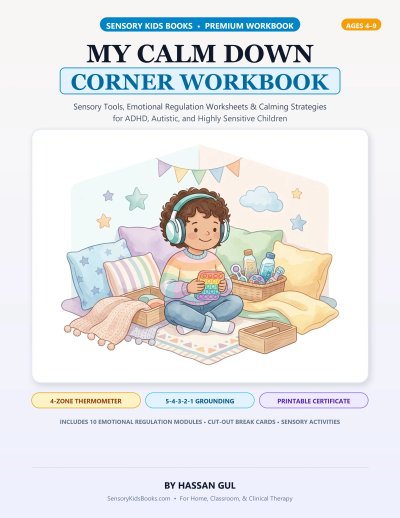 Instant PDF
My Calm Down Corner Workbook
Sensory Tools, Emotional Regulation Worksheets & Calming Strategies for ADHD, Autistic, & Sensitive Kids (Ages 4–9)
Quick Answers for Parents & Educators
Recommended Sensory Products
Carefully curated products for a sensory-friendly environment.

Weighted Blanket for Kids
PROPRIOCEPTIVE INPUT
Provides gentle, even pressure to calm the nervous system and promote deep, restorative rest.

Alpine Muffy Kids Noise Canceling Earmuffs
AUDITORY RELIEF
Passive hearing protection that reduces loud environmental noises while still allowing your child to hear you.

Sensory Chew Necklaces
ORAL SENSORY
Safe, food-grade silicone chewies to help satisfy oral sensory-seeking behaviors and improve focus.
📚 Evidence-Based Sources & Citations
Peer-reviewed literature, clinical frameworks, and foundational neurodiversity resources referenced in this guide.
- Occupational Therapy Practice Framework: Domain and Process (4th Edition) — American Occupational Therapy Association (AOTA)(2020)View Sourceopen_in_new
- The Polyvagal Theory: Neurophysiological Foundations of Emotions, Attachment, Communication, and Self-Regulation — Dr. Stephen W. Porges, PhD(2011)View Sourceopen_in_new
- Understanding Pathological Demand Avoidance (PDA): Identifying Needs & Low-Demand Approaches — PDA Society UK(2023)View Sourceopen_in_new
- Sensory Processing Issues Explained: Supporting Children with Sensory Sensitivities — Child Mind Institute(2024)View Sourceopen_in_new
Join the Conversation
Get our monthly guide on sensory-aware parenting and neuro-inclusive home design delivered straight to your sanctuary.
Respecting your inbox and your peace of mind.
Leave a Reply
Your email address will not be published. Required fields are marked *